
Co-develop your scenario

Bring us the operation your current stack works around.

QuikSync is built scenario-agnostic, so the fastest way in is to co-develop around a real challenge of yours. You bring the operation; we model it, connect what you already run, and commission a bounded first outcome, then turn what works into reusable product for the next site and use case.

Thirty days, end to end

Day30You have the controls.

Yours to run from that day, on licence. Months 2–3 harden the operation; over the six to twelve months that follow, it compounds across new scenarios, sites and machines.
  • Day 7your operation runs, in simulation
  • Day 21first live run on your real systems
  • Day 30your operators take the controls
  • Months 2–3the operation hardens on your own floor

The month, week by week

TogetherWe buildYou clear the path

  1. Together — Consultation, day 0
  2. Together — Frame one outcome, days 1–3
  3. We — Your world, modelled from packs, days 2–6
  4. We — Workflows authored · boundary set, days 4–8
  5. Together — Venture terms signed, days 4–9
  6. You — Site access opened to us, days 4–9
  7. We — The operation runs — in simulation, days 7–13
  8. You — Suppliers negotiated · assets ordered, days 9–14
  9. We — Lifts, doors & controls retrofitted, days 10–17
  10. We — Your systems joined, one by one, days 14–20
  11. You — Assets delivered to site, days 16–22
  12. We — On-site commissioning · first live runs, days 21–27
  13. Together — Your crew at the controls, with us, days 24–27
  14. Together — Handover — you run it, we spot, days 28–30
  1. Days 0–6

    day 0 · consultation

    day 3 · outcome locked

    From first conversation to a committed outcome.

    Together

    • A working consultation turns your operation into a structured scenario brief
    • One outcome framed, and the success criteria we will both be held to

    We build

    • A straight answer on fit, inside the first week
    • Your world modelled from operation packs proven elsewhere
    • Workflows authored; the permission boundary set — who may act, on what

    You clear the path

    • Bring the real operation, not the sanitised version
    • A decision-maker at the table
    • Site access opened to us
  2. Days 7–13

    day 7 · first sim run

    It runs in week two — before your site is ready.

    Together

    • Venture terms signed — one agreement, not a procurement cycle

    We build

    • Your operation running in simulation from day seven
    • Hardware work starts on your floor — lifts, doors, controls

    You clear the path

    • Suppliers negotiated and assets ordered
  3. Days 14–20

    day 14 · first system joined

    Your estate joins the operation.

    We build

    • Your systems joined one by one, as configuration
    • Lifts, doors and controls retrofitted and proven
    • The operation exercising against the real estate

    You clear the path

    • Assets delivered to site
  4. Days 21–27

    day 21 · first live run

    Real systems, real runs, real evidence.

    Together

    • Your crew at the controls, with us alongside

    We build

    • We commission on your floor — running live from day twenty-one
    • The evidence packet out of the Operations Ledger

    You clear the path

    • Your floor released for live running
  5. Days 28–30

    day 28 · handover begins

    day 30 · controls yours

    Handover — and the venture begins.

    Together

    • Handover begins on day twenty-eight; by day thirty you are running it and we are spotting
    • Measured against the criteria you signed in week one

Thirty days is a joint commitment, not a delivery promise. Our lane is the build. We tailor the platform, join your systems, retrofit the hardware, and run the operation on your floor. Yours is shorter, and it gates all of it: site access and suppliers brought to commitment.

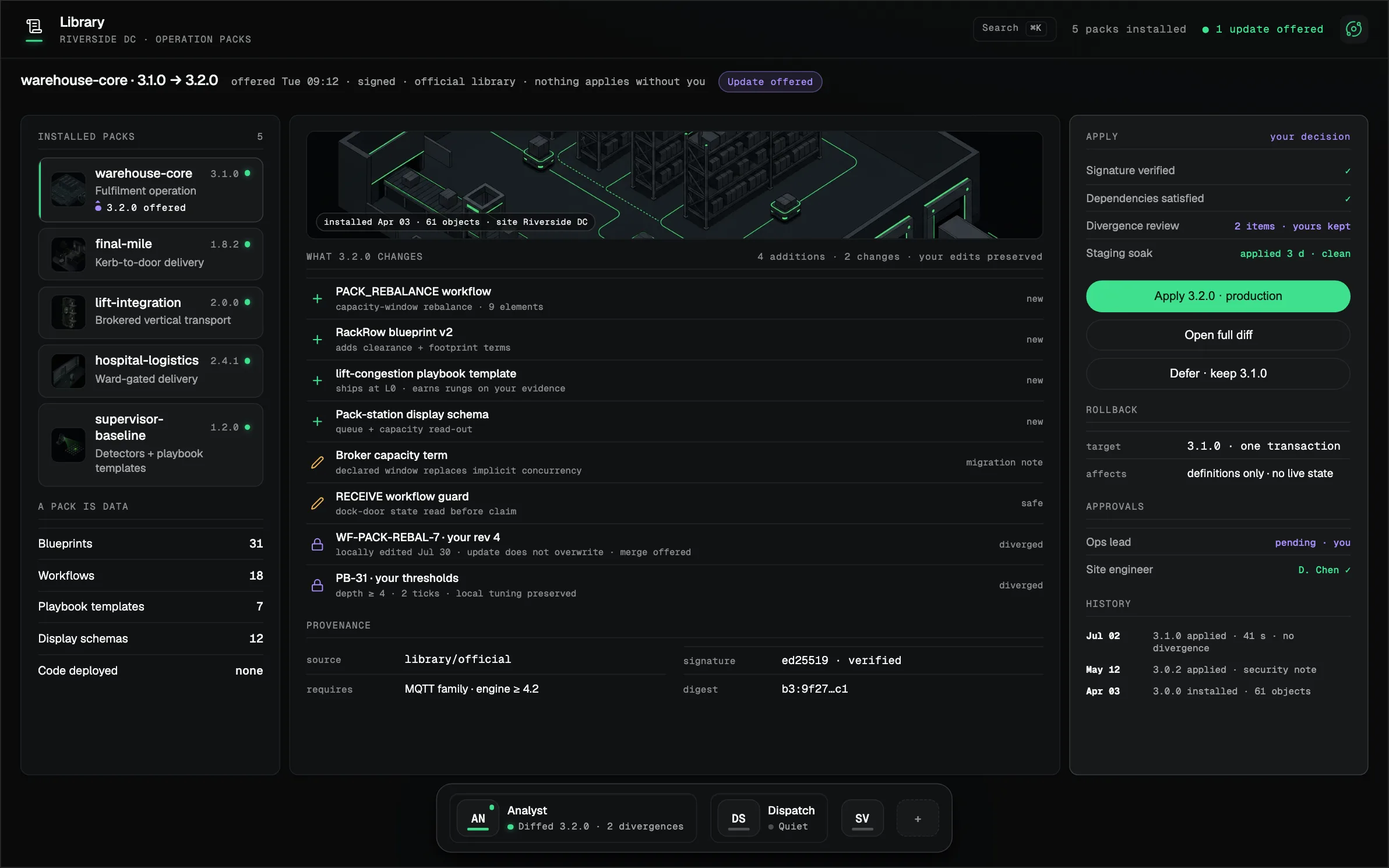
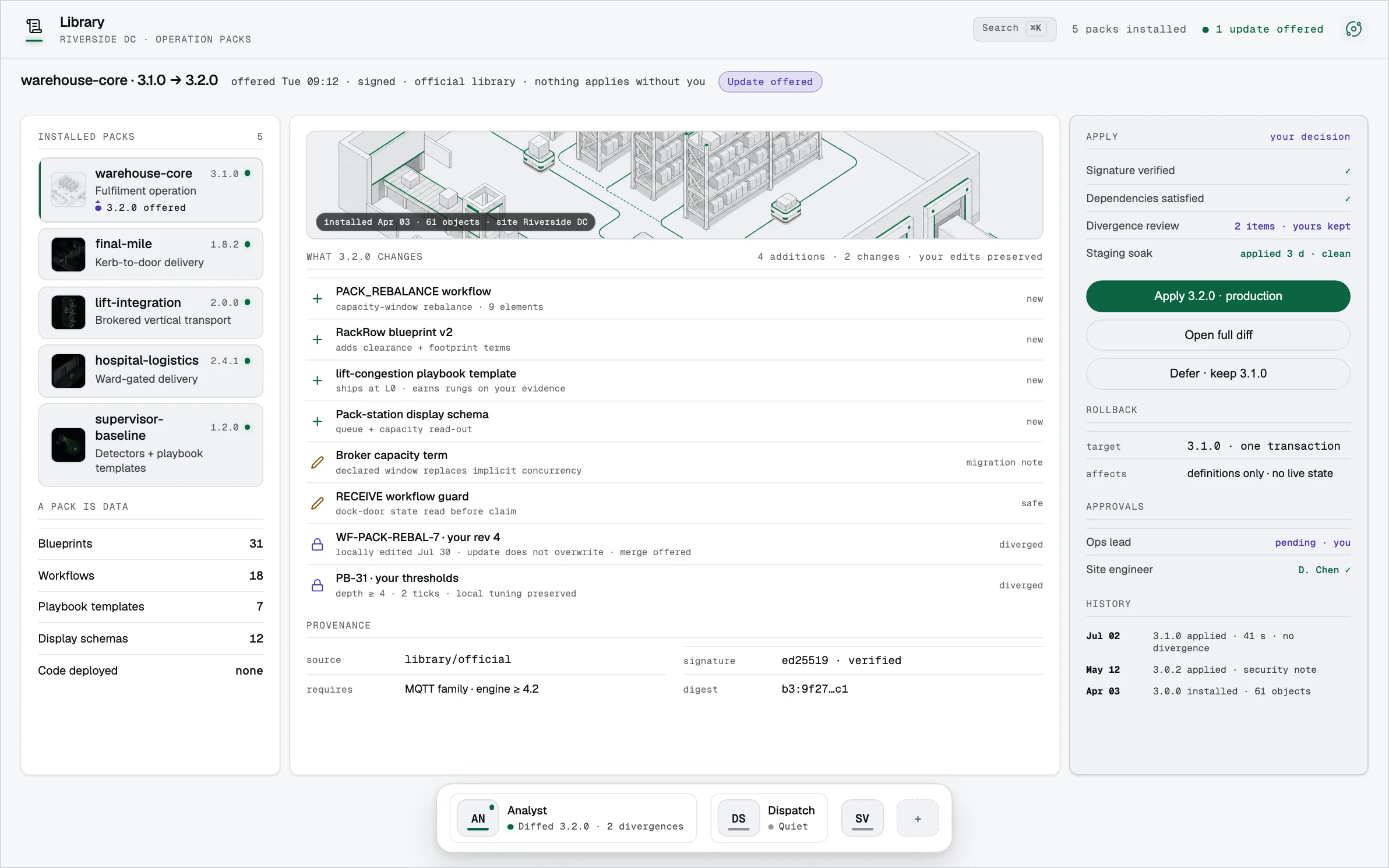
  • Illustrative Pack Library console: a scenario pack upgrade with its skills diff, approvals, and rollback target in view.Illustrative Pack Library console: a scenario pack upgrade with its skills diff, approvals, and rollback target in view.
    Illustrative product concept. Interfaces and data are representative.

    Where the speed comes from

    Your challenge becomes something the platform can run.

    Modelling starts from an operation that already runs elsewhere.

    Where a scenario pack already covers your domain, week one is divergence rather than invention. Your challenge is expressed in the platform's common language, the actors and resources and jobs it already knows, which is what makes it executable rather than a slide. The surfaces each team will actually use, an app per role and per site, are specified alongside the world they read from. Your scenario sharpens a platform that stays scenario-agnostic, and you inherit the head start of every operation modelled before yours.

  • What you already run

    Join your systems as a data change, not a rip-and-replace.

    Fleets, lifts, doors and building systems, through one plane.

    The machines, shared infrastructure, and enterprise systems already in the loop connect through the vendor-agnostic connector plane, and a connector that already exists installs against the database without a redeploy. Nothing that works today is thrown away. Specialist systems keep their jobs while QuikSync governs the work between them.

  • Who may act

    Decide who may act—before anything of yours moves.

    Decide it once; the Permission Plane applies it to every job.

    Define who may decide, approve, act, and intervene, then encode it: which tenants and roles hold authority, which resources each job may touch, and which steps stop for a person. The Permission Plane resolves that against the live operation as work is allocated, so the rule holds at the moment of the action.

  • What the first run proves

    Run one high-value outcome against real systems.

    A bounded first deployment, from reusable operation packs.

    The first operation runs end to end against your real systems, composed from reusable packs rather than bespoke integration. The Operations Ledger records every decision, command, effect, and exception as replayable proof, measured against the success criteria you set with us in week one and handed to the people who have to weigh it: operators, boards, insurers, and regulators.

  • What you keep

    The first operation becomes an asset the estate reuses.

    What one site proves, the next site starts from.

    What works widens by scope: a validated operation the rest of the site reuses, a model the next site inherits, portfolio standards the estate owns. The commission compounds instead of resetting.

Bring us your challenge

Start with one bounded outcome, and the proof to back it.