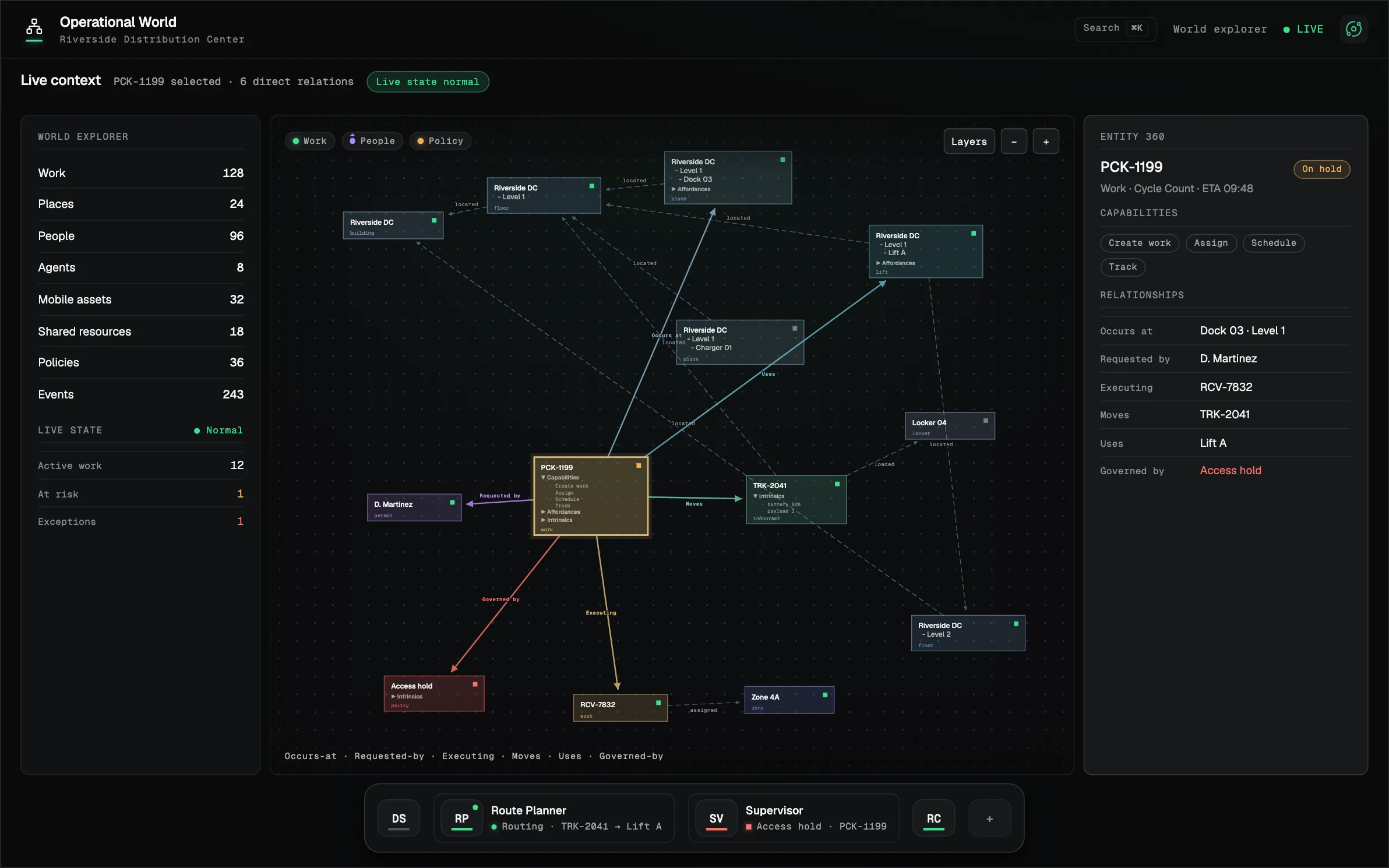
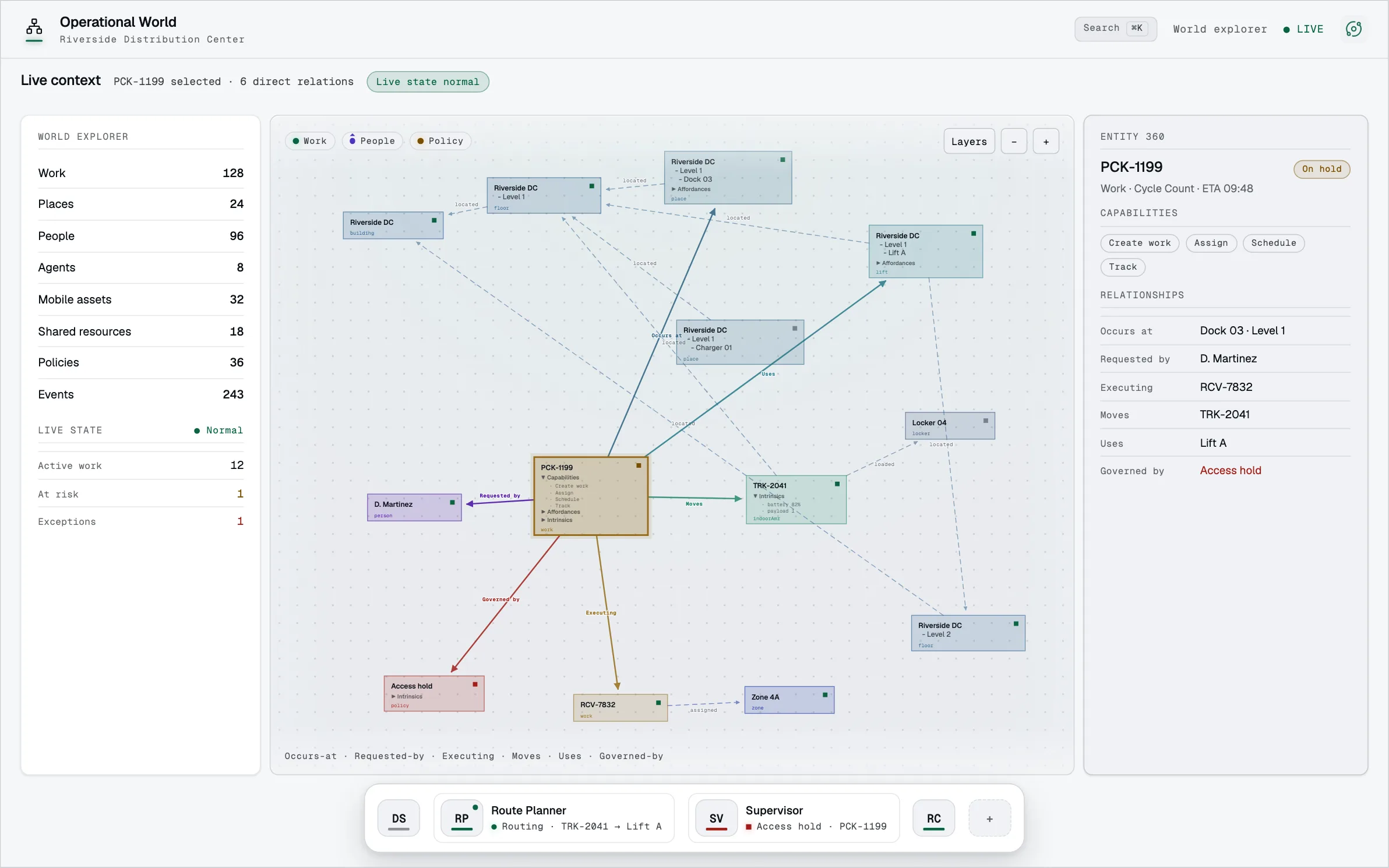
• Illustrative Operational World console: a live entity-relationship graph over the site, with an Entity 360 dossier.Illustrative Operational World console: a live entity-relationship graph over the site, with an Entity 360 dossier.

    Operational ontology

    Model the operation as a living world.

    Every actor, place, and job in one typed world.

    A place, a machine, a job, and the live state of each become one typed vocabulary that every application and action reads from. It is a platform primitive, not another scenario fork. Because each fact is modelled once and stays distinct, adding a vendor, a fleet, or an entire scenario is a data change against the shared world rather than a new branch of code, and every surface sees the same state.

    • Actors, resources, places, and relationships
    • Capabilities and live state
    • Spatial and operational context
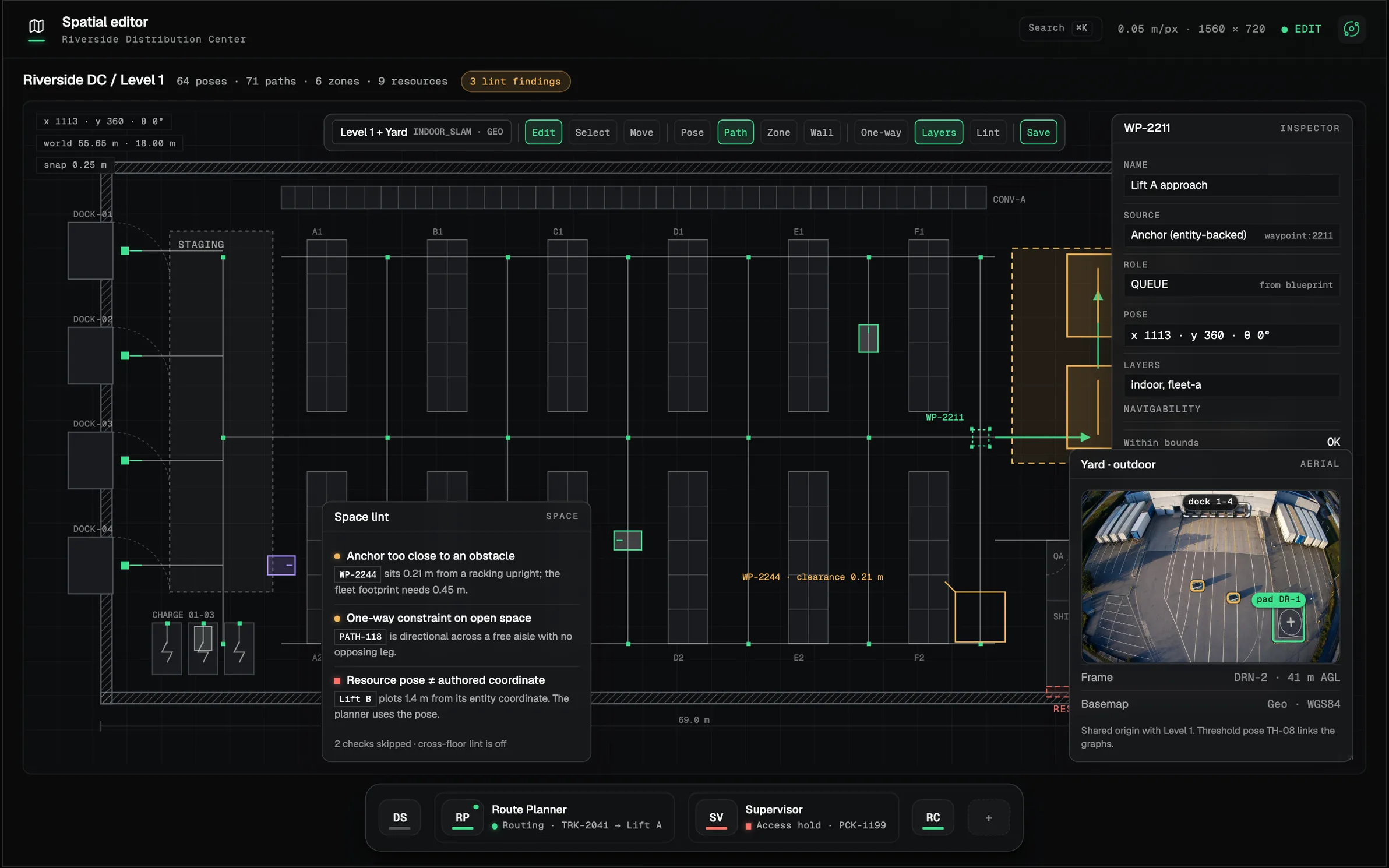
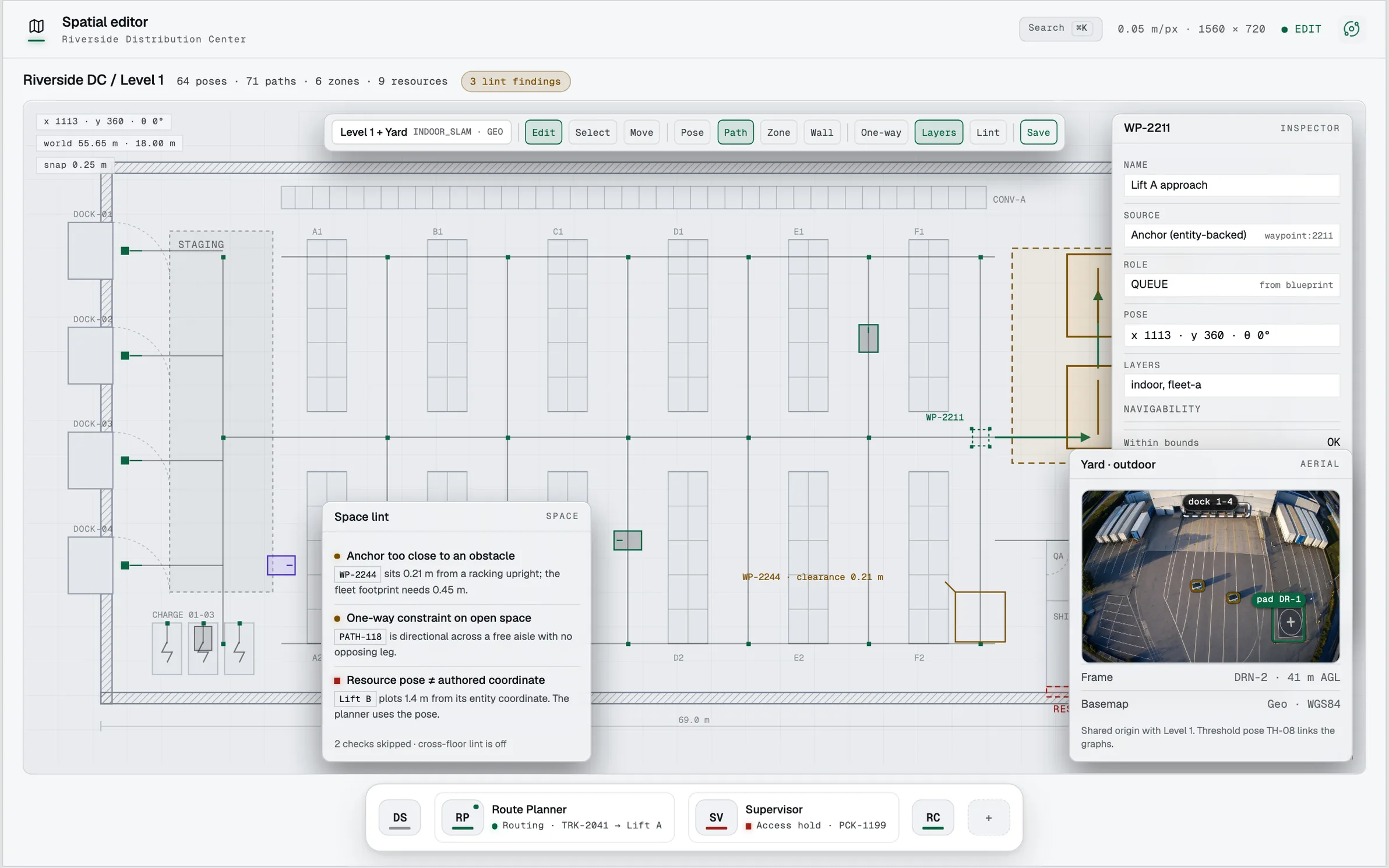
  • Illustrative Spatial editor: a floor plan authored as poses, routes, zones, and resources, with lint findings and a navigability read-out.Illustrative Spatial editor: a floor plan authored as poses, routes, zones, and resources, with lint findings and a navigability read-out.

    Spatial authoring

    Author the space the operation actually runs in.

    The floor is data: geometry, routes, zones, rules.

    A site is not a backdrop. Floors, docks, aisles, lifts and the routes between them are authored as data on the world every application reads, so a bay moves or a restricted zone tightens without a code change or a vendor ticket. Placement is checked where it is made — clearance, reachability, coherence across levels — so a waypoint drawn inside a wall is caught at authoring time rather than stranding a mission hours later.

    • Poses, routes, zones, and resources as data
    • Clearance, reachability, and cross-floor checks
    • Navigability read-out at the point of edit
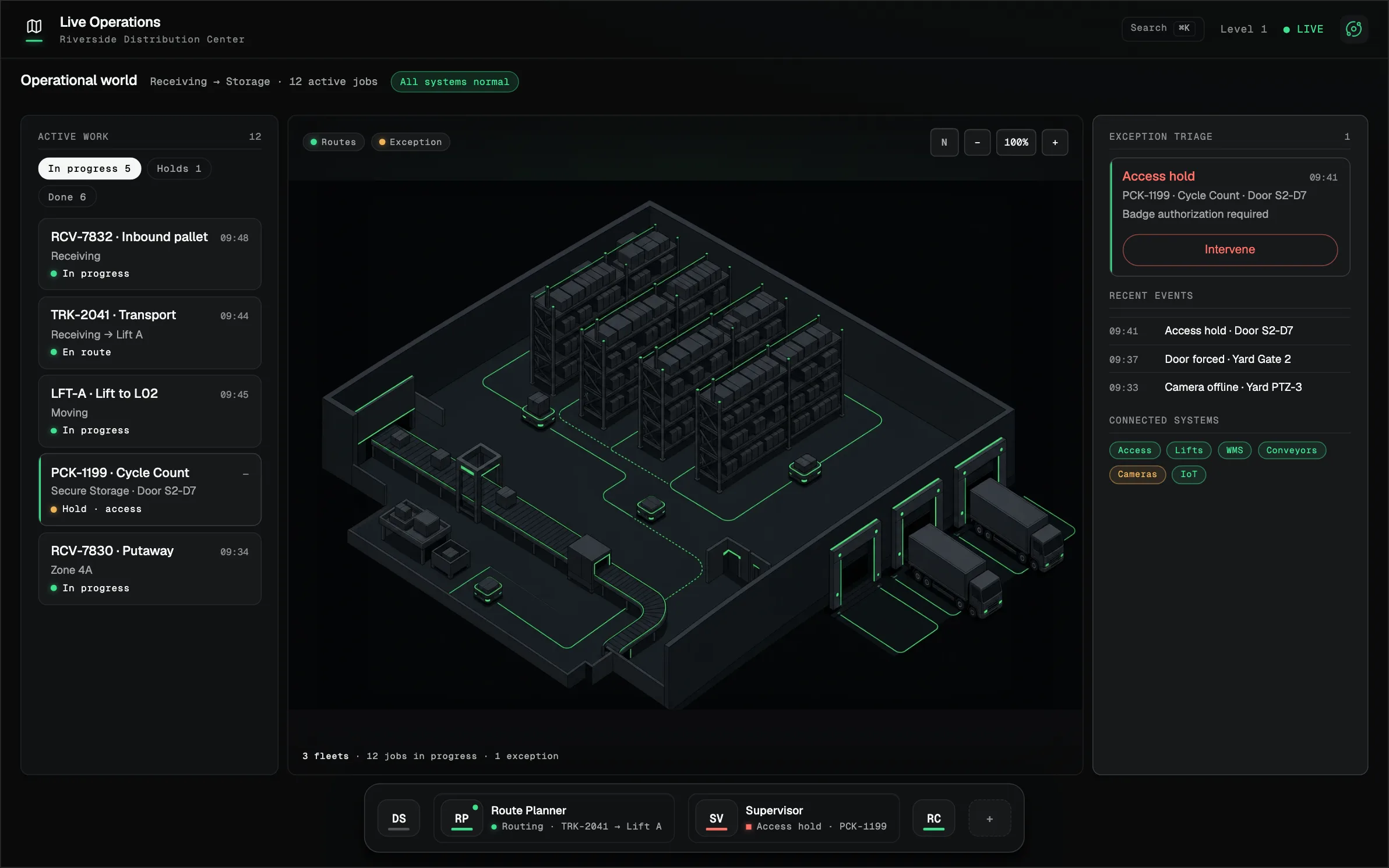
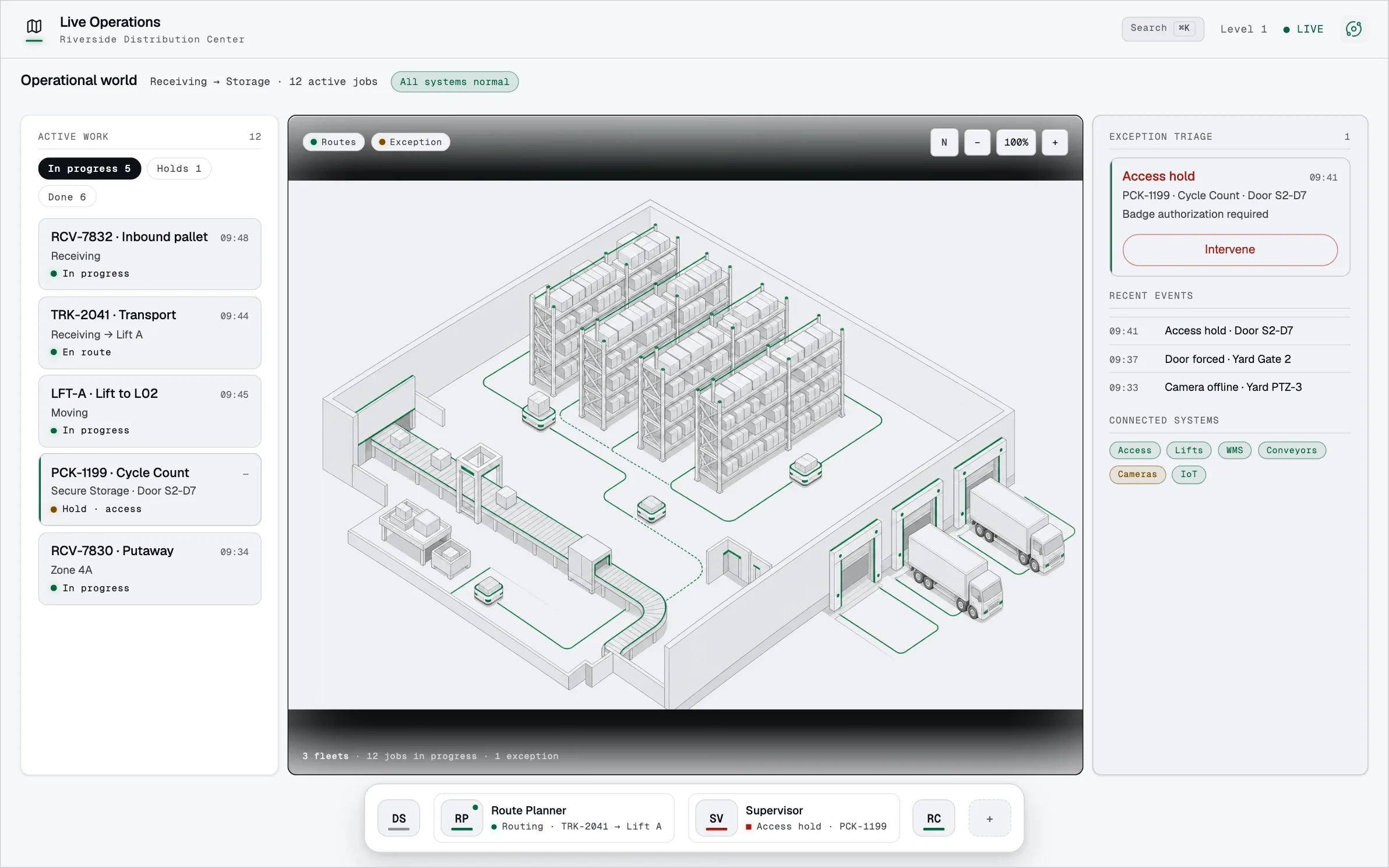
  • Illustrative Live Operations console: an operational map with active work and exception triage.Illustrative Live Operations console: an operational map with active work and exception triage.

    Coordination and integration

    Run mixed assets and shared infrastructure on one plane.

    Connect the vendors you have; share the building.

    Capacity- and priority-aware allocation assigns work across mixed-asset fleets, while indoor, graph and hybrid navigation coordinates movement through floors, corridors and shared spaces. A neutral connector plane carries commands into the machines, lifts, doors and building systems the estate already runs — REST, MQTT, VDA5050, vendor protocols, Open-RMF included. Vendors that never planned to cooperate queue for the same lifts under the same rules.

    • Capacity- and priority-aware allocation
    • Multi-floor indoor, graph and hybrid navigation
    • REST, MQTT, VDA5050 and Open-RMF adapters
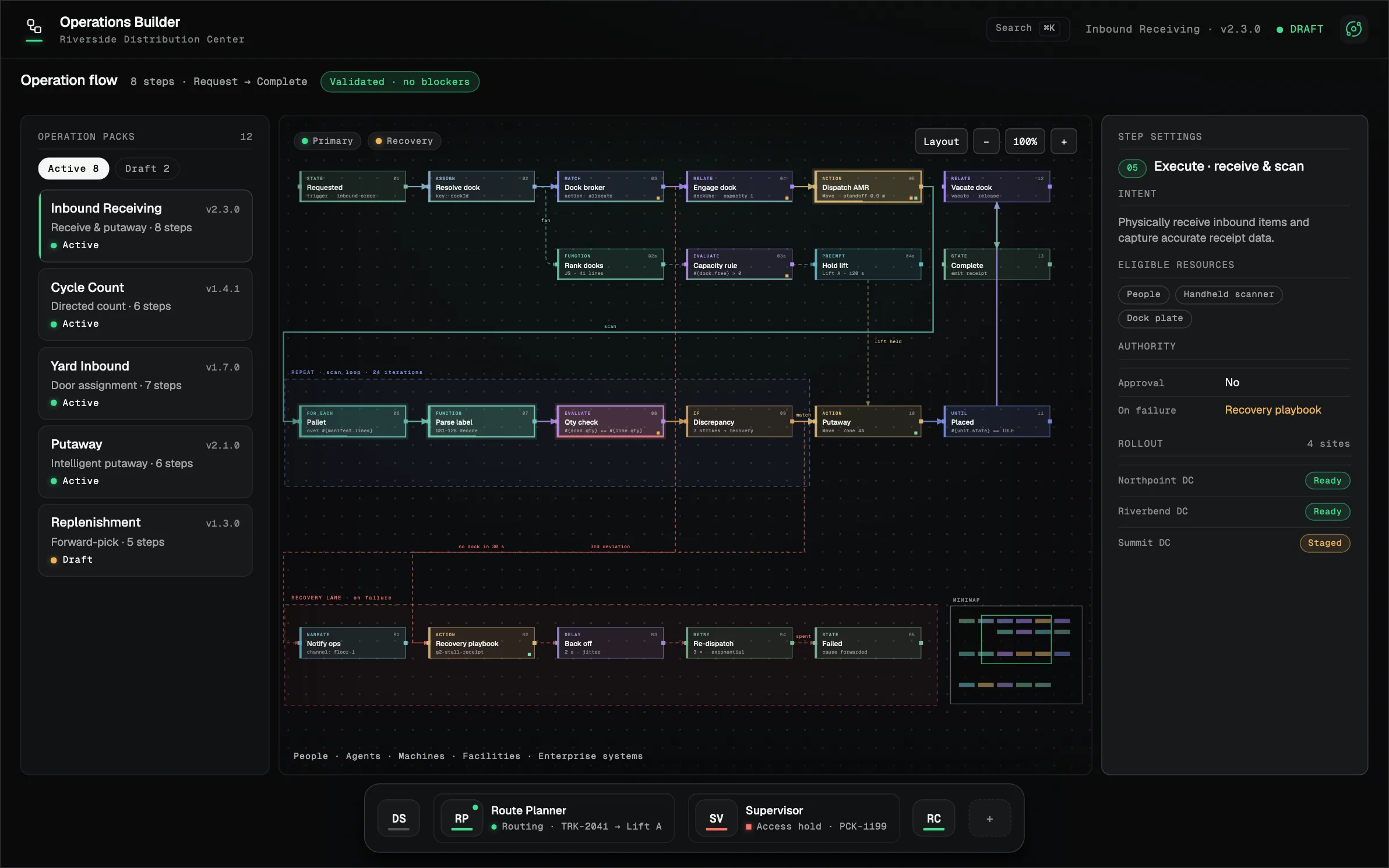
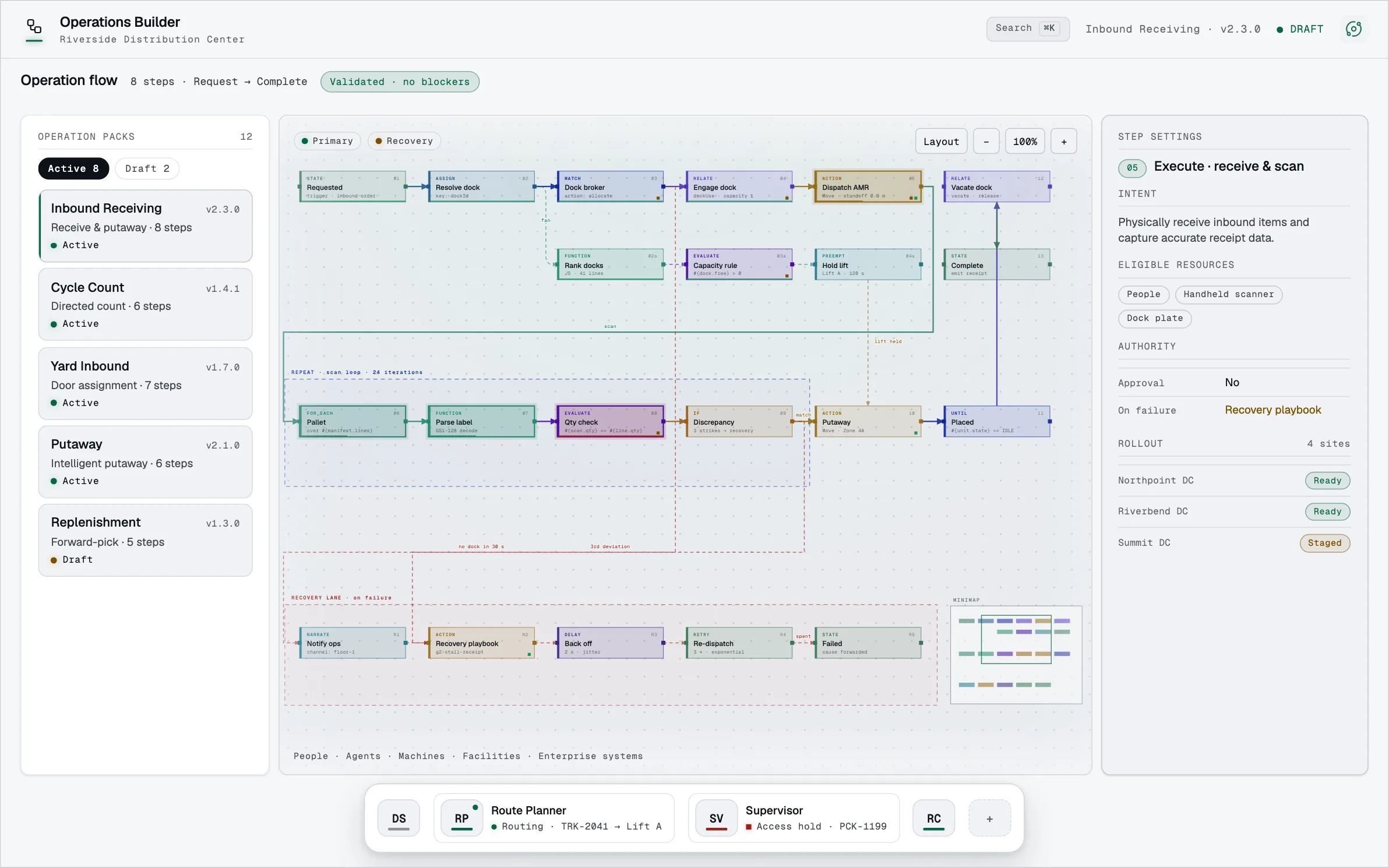
  • Illustrative Operations Builder console: a reusable operation flow with step settings and multi-site rollout.Illustrative Operations Builder console: a reusable operation flow with step settings and multi-site rollout.

    Operational applications

    Turn one world into every application the operation needs.

    Applications inherit the world instead of rebuilding it.

    Workflows, reusable operation packs, guided sessions, the Agent Deck and agent tools all stand on the same world rather than rebuilding one each. Each inherits the live context, authority path, integrations and evidence already in place, so an application ships as configuration over shared primitives — a tenant's delivery app, a service-counter tablet, a security console, all reading the same declared world.

    • Canvas and declarative workflows
    • Reusable packs and guided sessions
    • Data-shaped surfaces per role and site
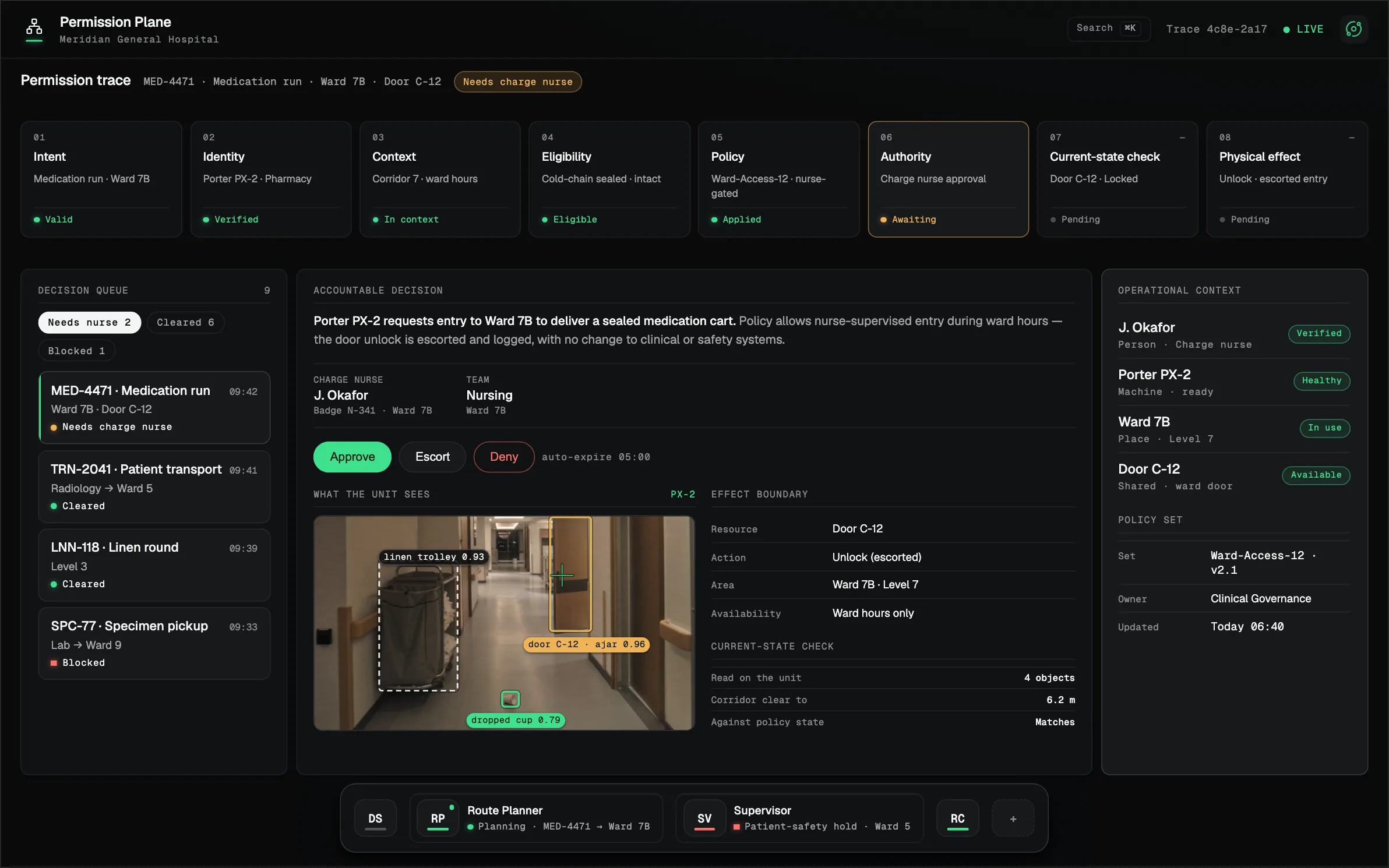
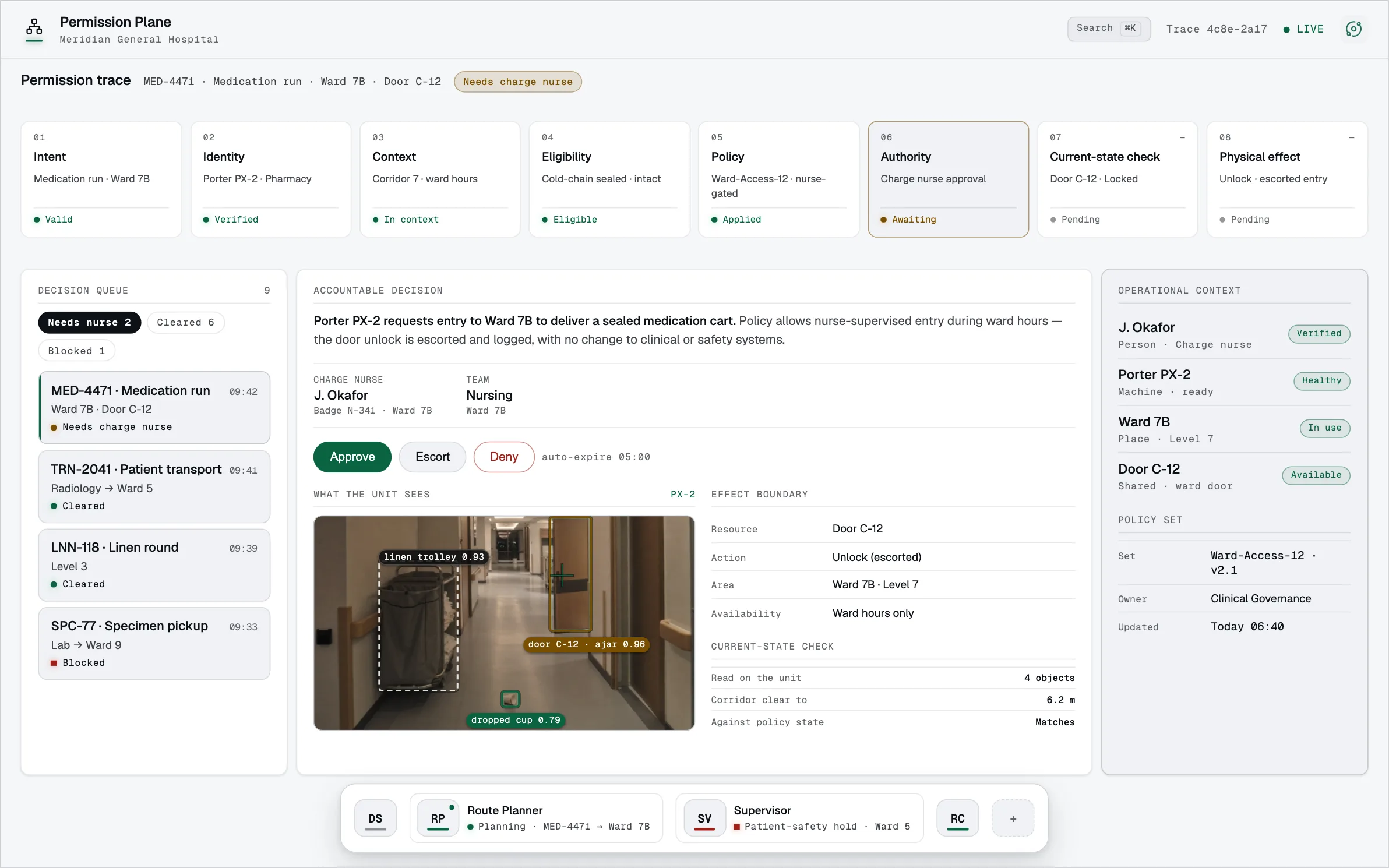
  • Illustrative Permission Plane console tracing identity, context, eligibility, policy, and human authority before a controlled door unlocks.Illustrative Permission Plane console tracing identity, context, eligibility, policy, and human authority before a controlled door unlocks.

    Ambient Permission Plane

    Put accountable authority in the path to physical action.

    Decide what may act while the decision still matters.

    Tenant identity and live context establish who is acting and inside which world. Broker eligibility and shared-resource allocation gate which people, machines and infrastructure a job may touch, so work reaches only what a deployment has enabled. Consequential and recovery steps escalate to an accountable operator, whose approval is recorded. Machine-level collision safety stays with each validated safety system.

    • Eligibility and shared-resource allocation
    • Human authority and escalation
    • Every consequential action answerable to someone
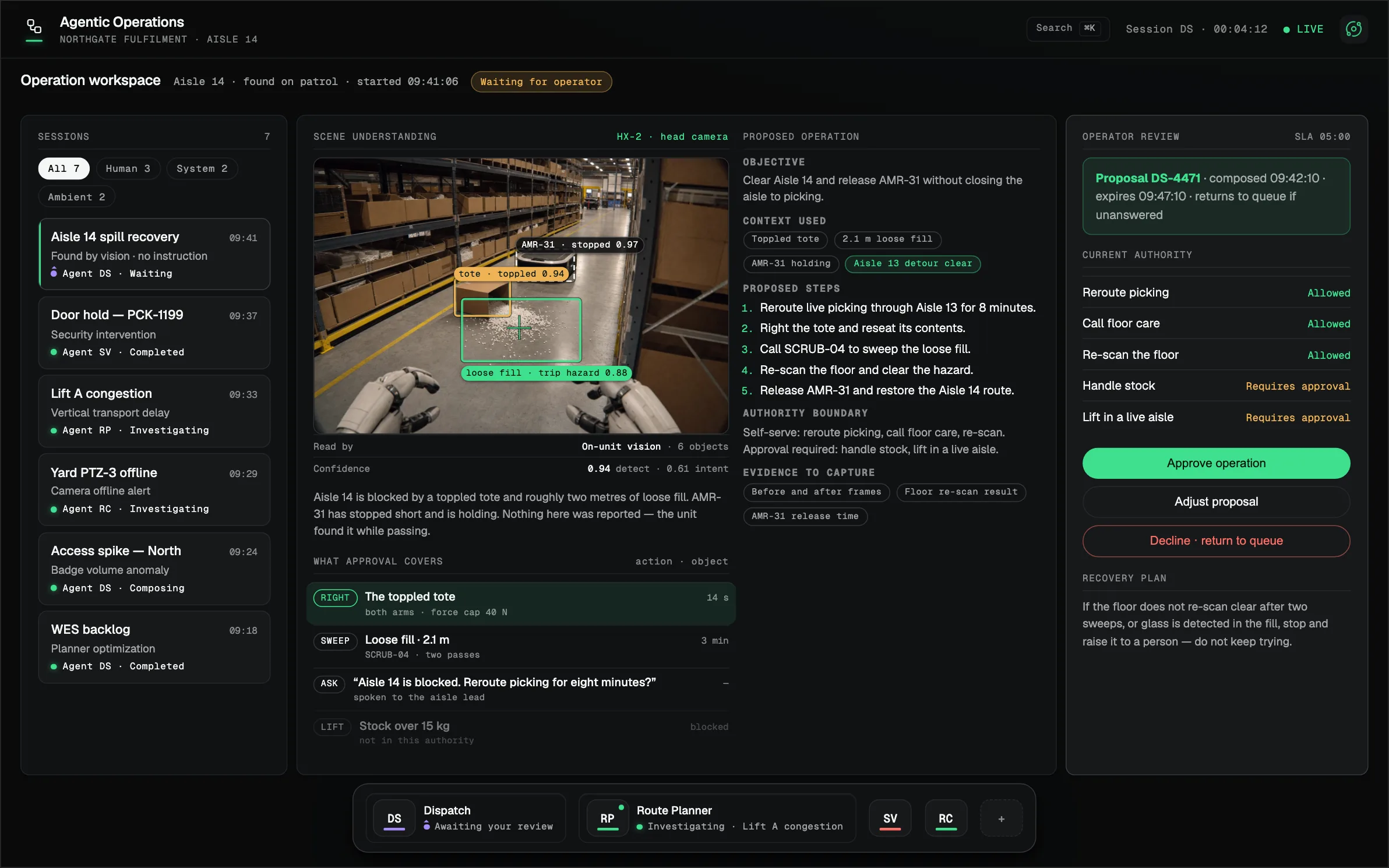
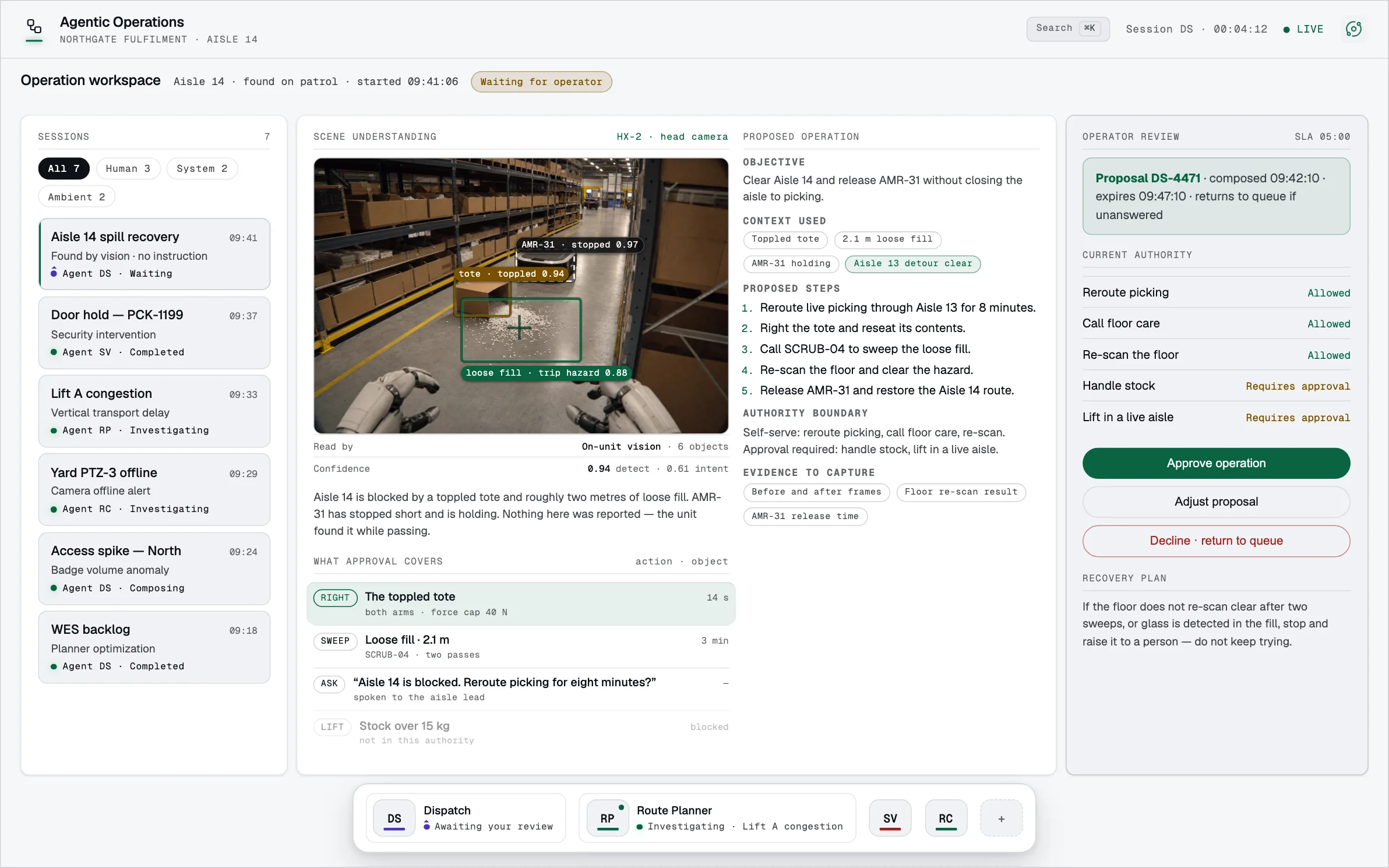
  • Illustrative Agentic Operations workspace where an agent proposes bounded action for accountable operator review.Illustrative Agentic Operations workspace where an agent proposes bounded action for accountable operator review.

    Agentic operations

    Give people and agents one governed way to act.

    Agents join the operation, not a parallel path to act.

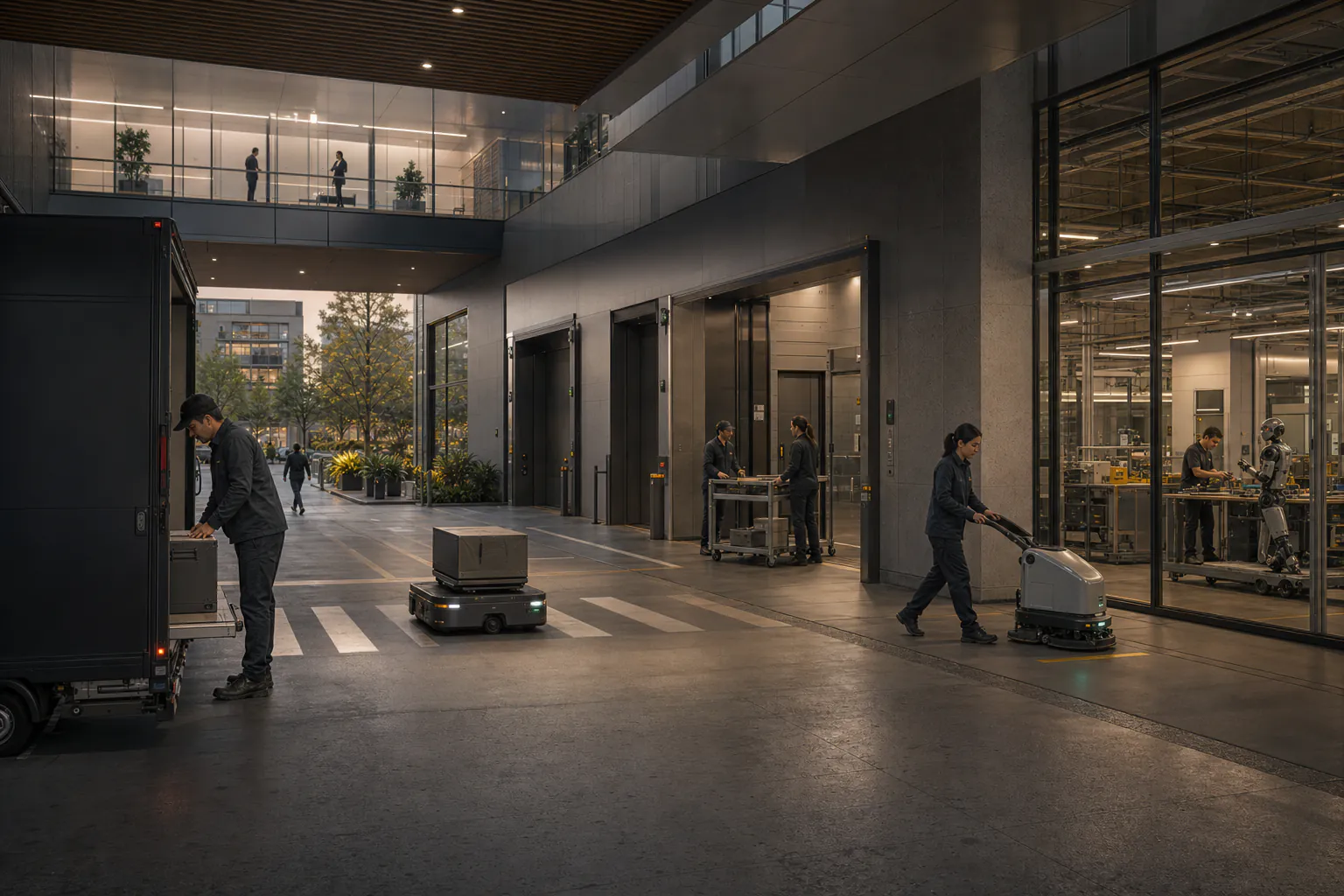
    Agents investigate, propose and take bounded action using the same world, tools and permissions as the people accountable for the outcome. Increasingly they start the conversation: a unit passing an aisle sees a toppled tote nobody reported, reads the scene, and brings a costed recovery rather than an alert. What an agent never gets is a parallel path to the floor — the same policy bounds it, the same record holds it, and a person can take back control.

    • Shared world, tools and permissions
    • Vision-grounded proposals, not alerts
    • Supervised intervention at any point
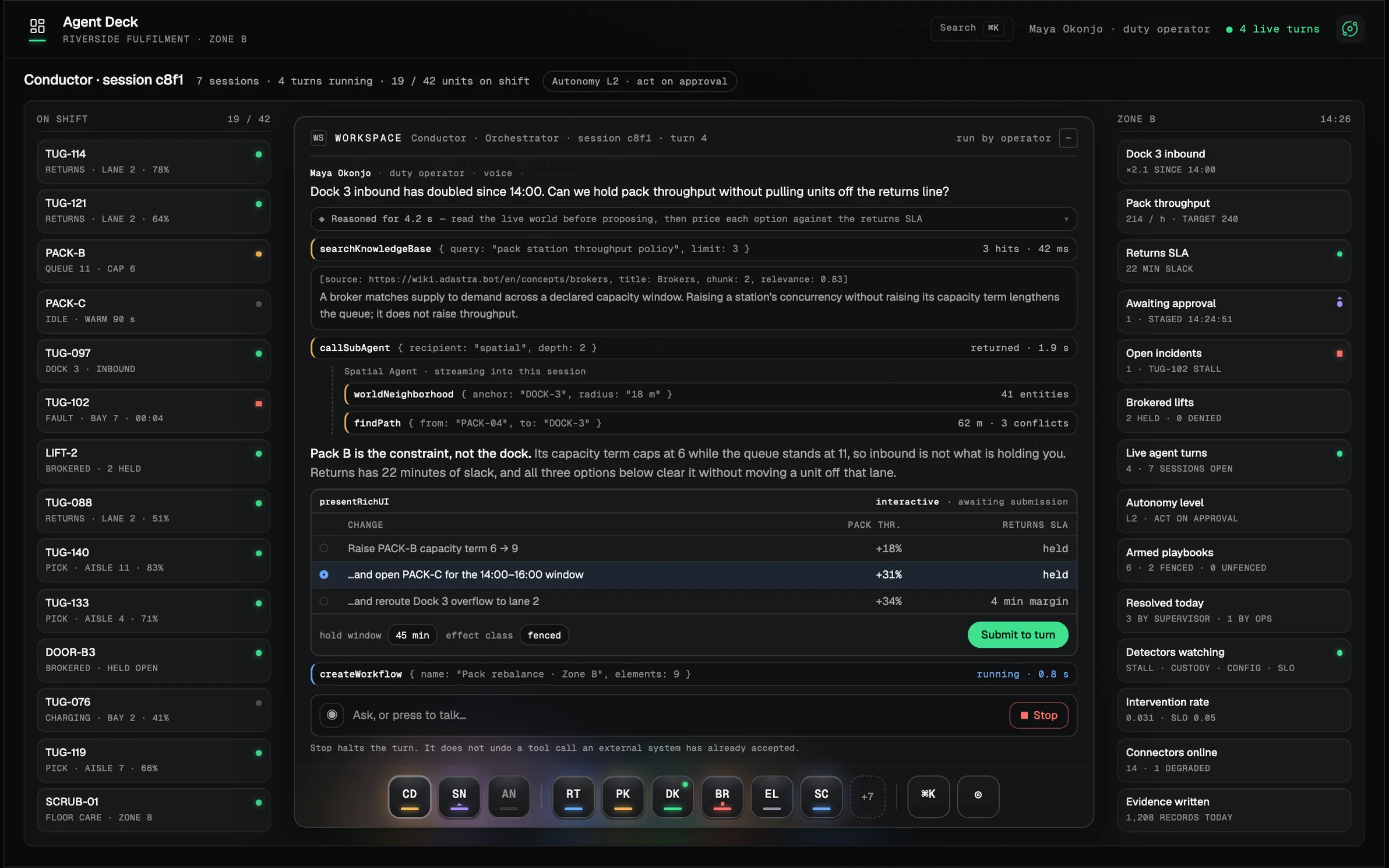
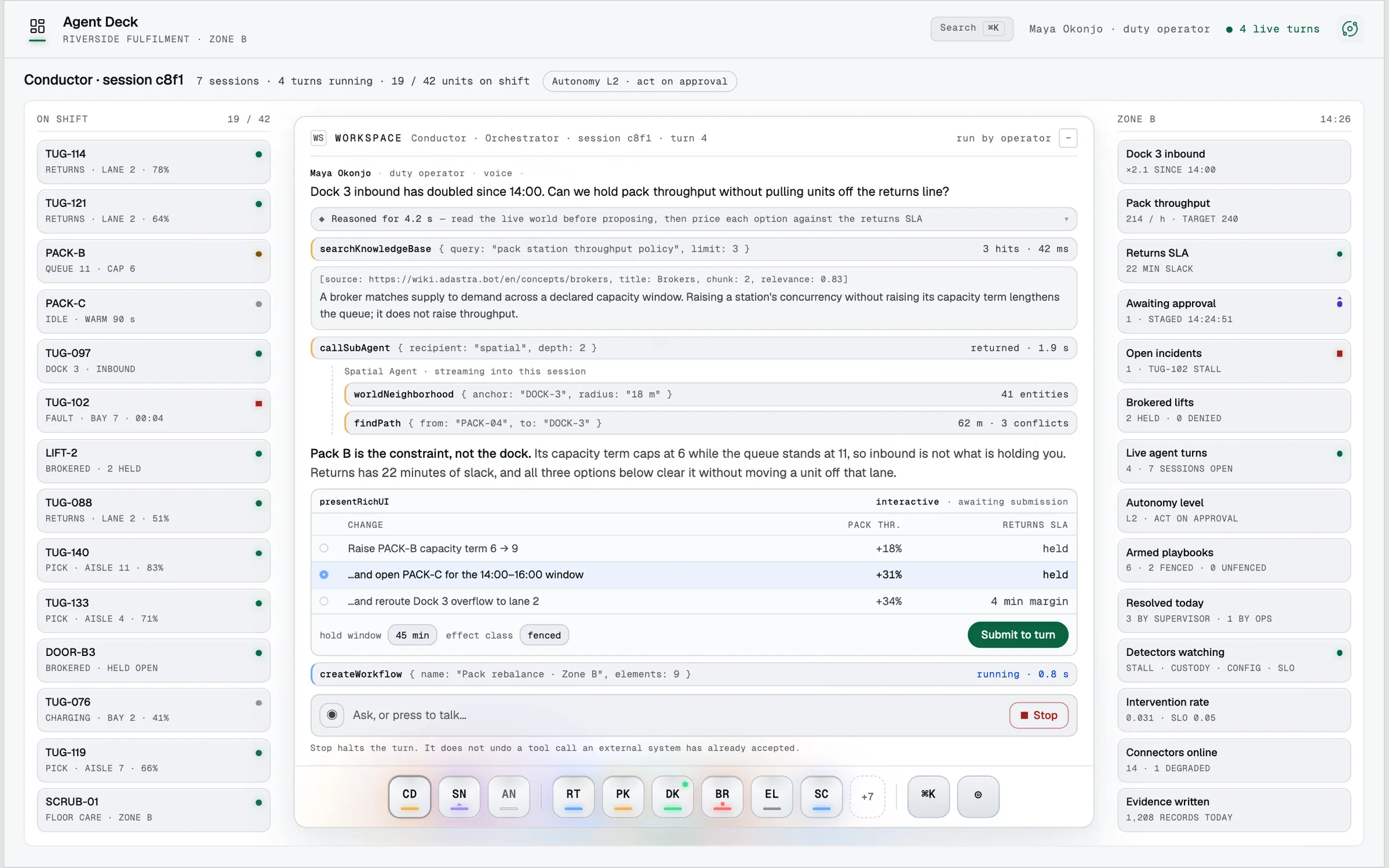
  • Illustrative Agent Deck: a dock of live agents under an open working transcript with tool calls, citations and an interactive surface.Illustrative Agent Deck: a dock of live agents under an open working transcript with tool calls, citations and an interactive surface.

    The Agent Deck

    One instrument for every agent on duty.

    Agent state as peripheral vision, not a tab.

    The deck is a dock of live agents along the bottom of every route: each key lights its own state, so a duty operator reads the whole crew at a glance instead of polling a queue. Open the one that needs you and it rises into a working surface — grounded in the live world, delegating to specialists in the same trace, citing what it relied on, answering with a surface you complete and submit back into the turn.

    • Every agent's state as a lamp, not a tab
    • A working transcript with citations and tool calls
    • Stop, approve or reject any turn
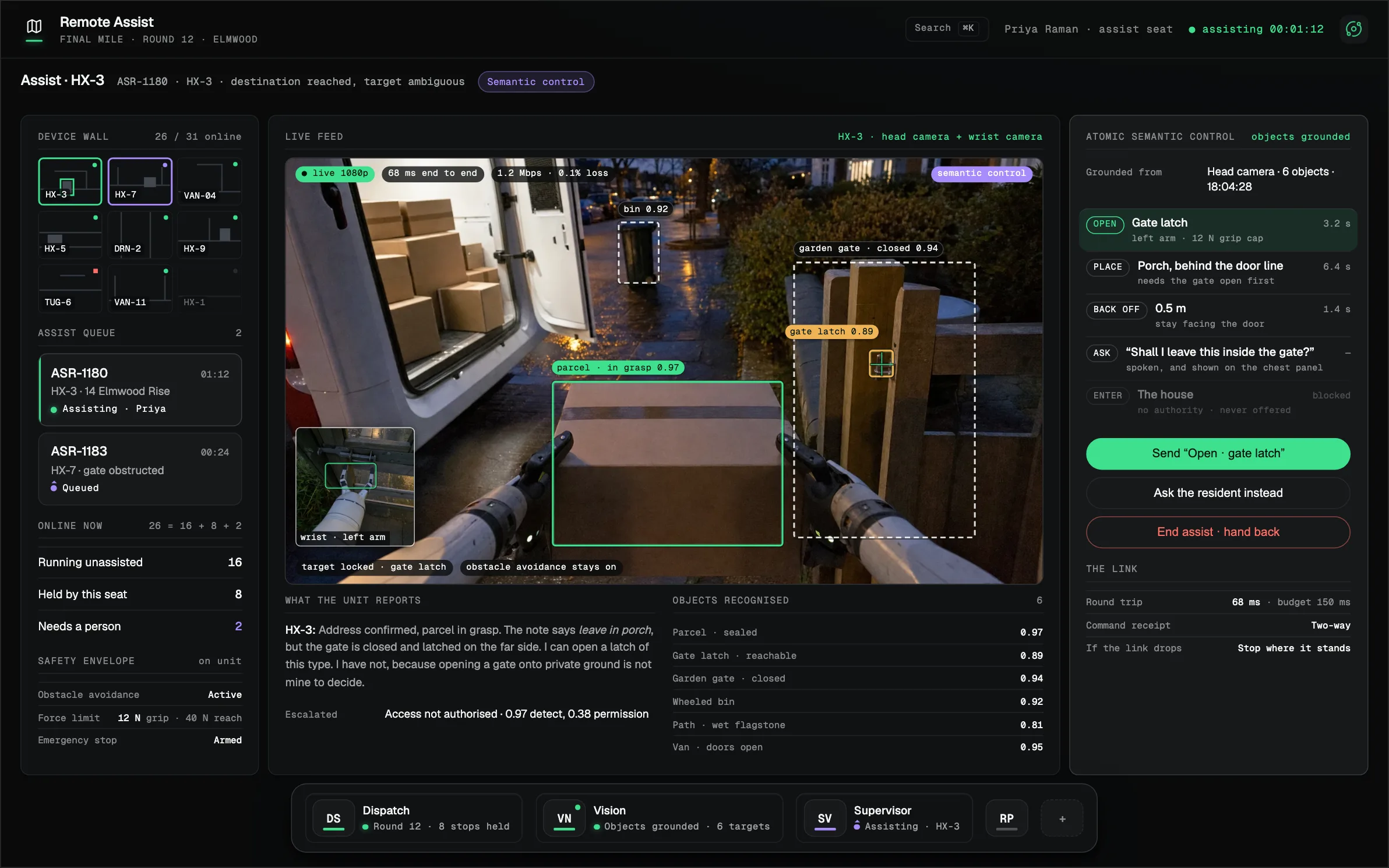
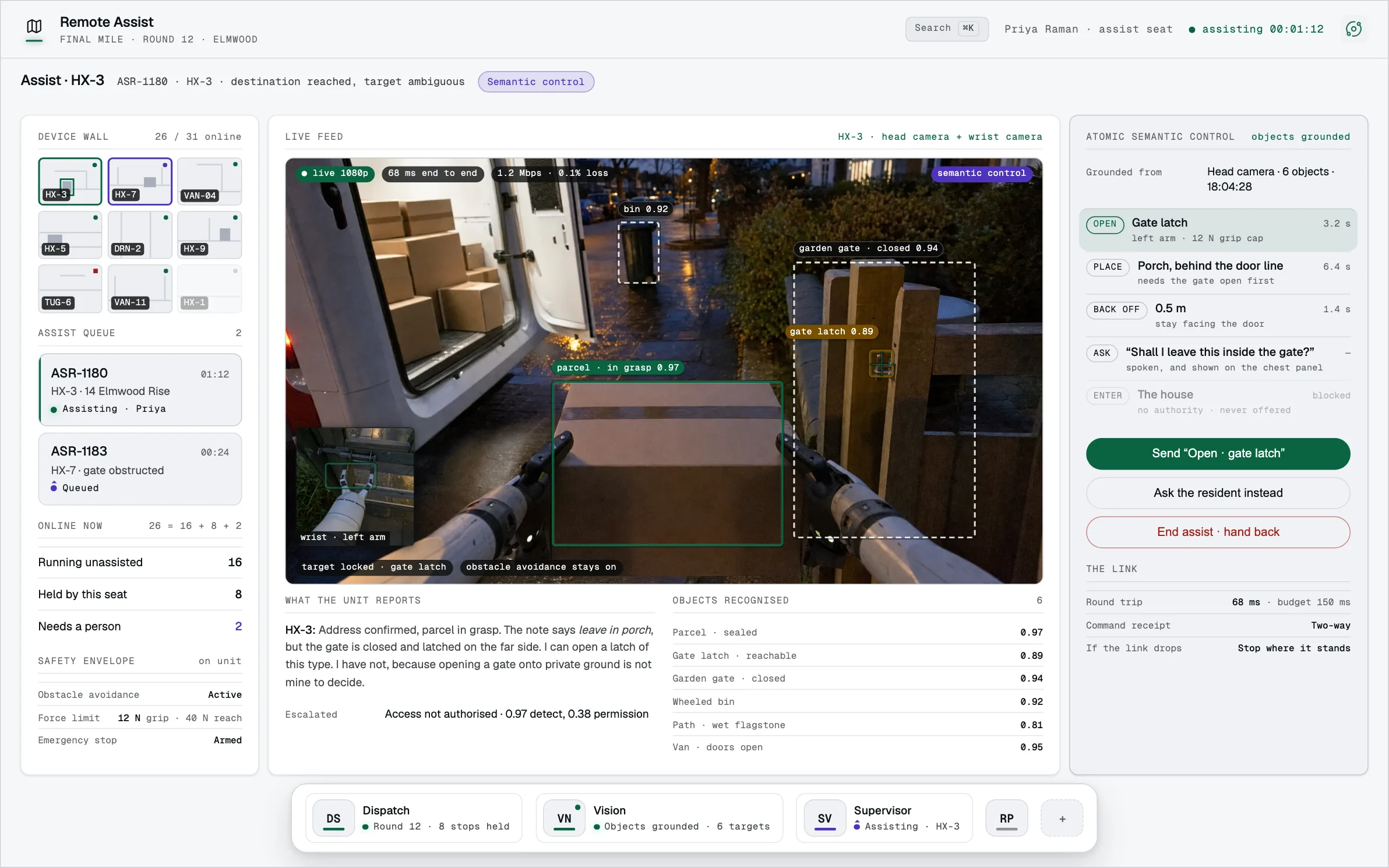
  • Illustrative Remote Assist seat: a device wall, a live head-camera feed with recognised objects named on it, and action-and-object commands.Illustrative Remote Assist seat: a device wall, a live head-camera feed with recognised objects named on it, and action-and-object commands.

    Remote assist

    Take the decision, not the joysticks.

    One seat covers a fleet: it is asked, not driven.

    Autonomy that never asks for help is autonomy nobody deploys. When a unit reaches a situation it can read but not decide — the address is right, the parcel is in hand, the gate onto private ground is closed — it stops and asks. The seat sees what the unit sees, objects already named on the frame, and answers with an action and an object. Avoidance, force limits and stop never leave the machine, so a slow link degrades the conversation, not the safety case.

    • Live feed with recognised objects named on it
    • Action-and-object commands, not joint control
    • One seat across a fleet, queued by who needs a person
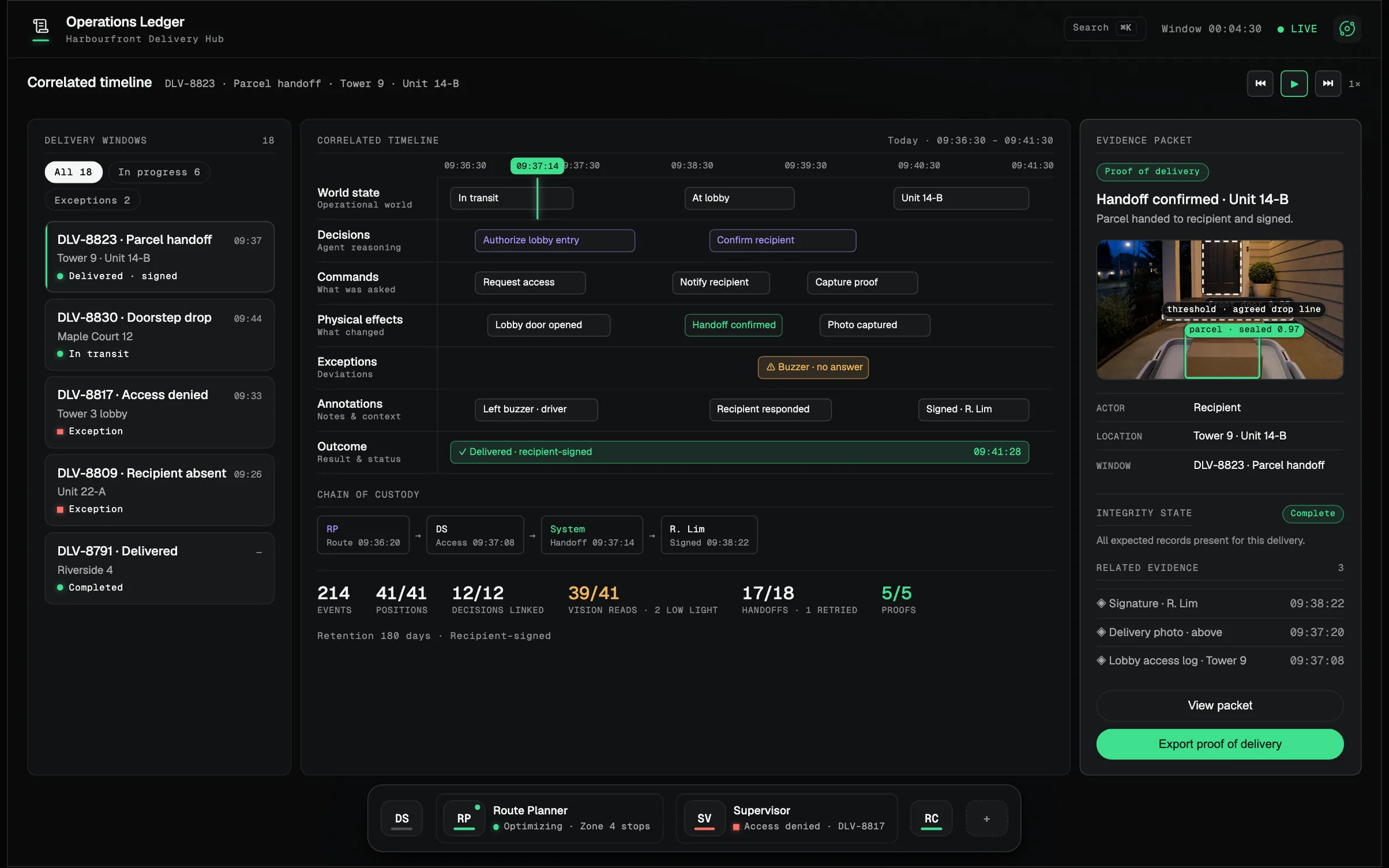
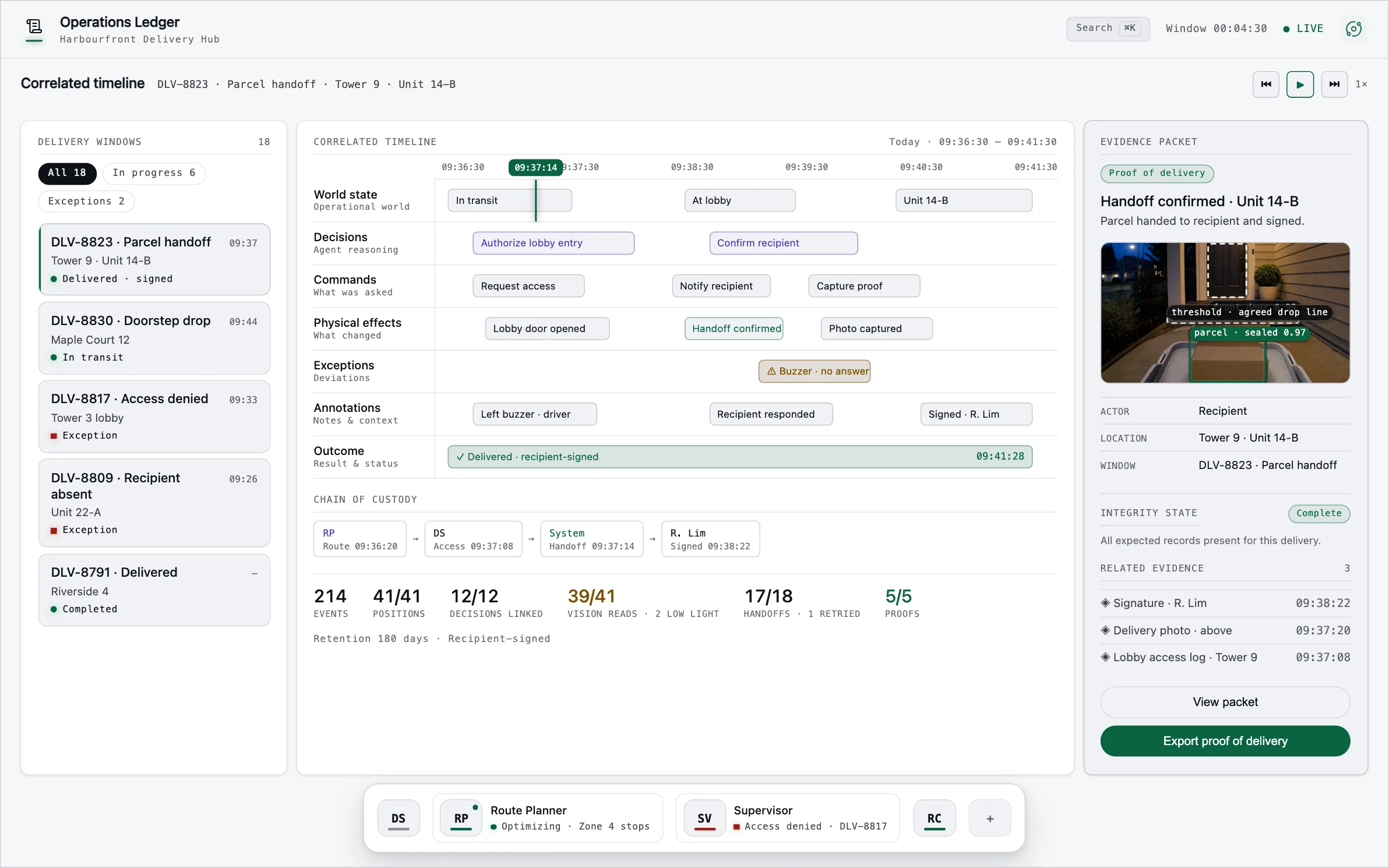
  • Illustrative Operations Ledger console: a correlated timeline and exportable evidence packet.Illustrative Operations Ledger console: a correlated timeline and exportable evidence packet.

    Operational Insurance

    Make every physical outcome part of the record.

    The record that makes a deployment answerable.

    The Operations Ledger keeps every decision, command and effect as one correlated, replayable narrative. Entries stay tied to the work that produced them, and to the operator who approved them where an action was supervised, so an incident window reconstructs end to end and exports as one packet a board or an insurer can read. That is what makes a deployment answerable: an account of the operation, not a diagnostic dump.

    • Operations Ledger with incident windows and export
    • Outcome and exception context
    • Connected decision and action history
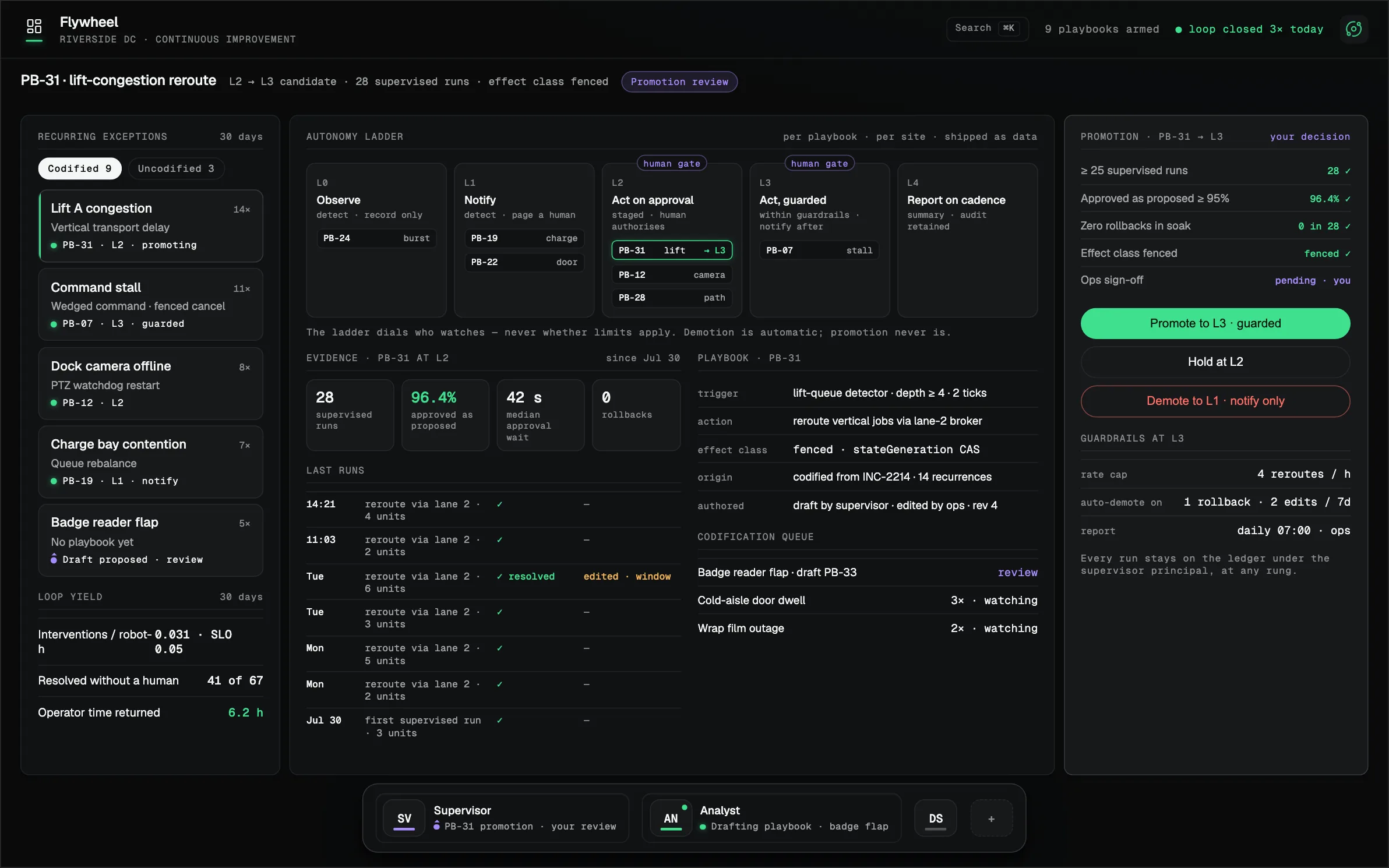
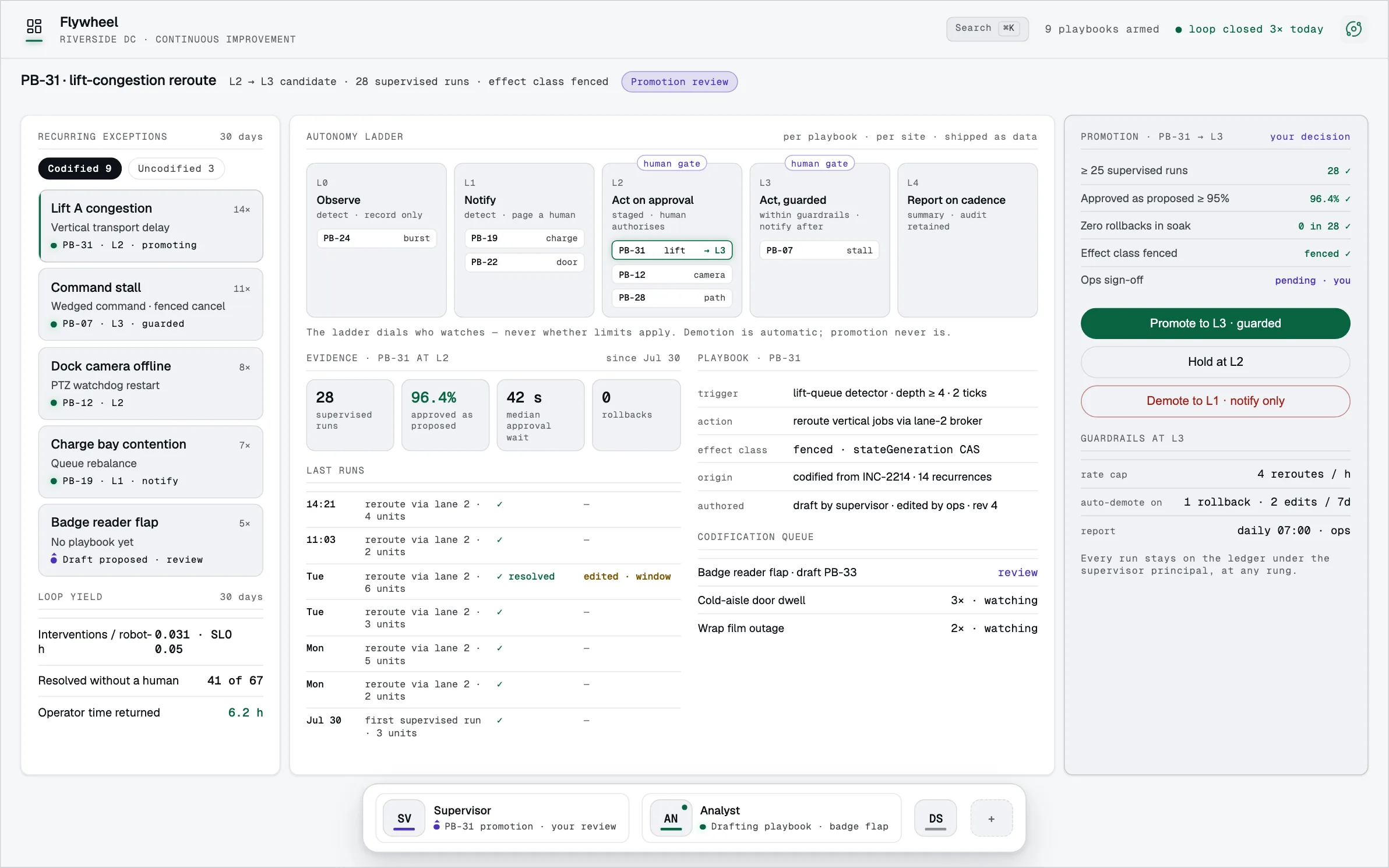
  • Illustrative Intelligence console comparing observed outcomes with evidence-grounded simulations.Illustrative Intelligence console comparing observed outcomes with evidence-grounded simulations.

    Intelligence flywheel

    An operation that stops needing you for the same thing twice.

    Playbooks earn autonomy; a human gates every rung.

    Every exception the operation survives becomes a candidate: recur three times and it is codified as a playbook — trigger, action and guardrails as data. A new playbook observes first, earns the right to notify, then to act on approval, then to act within guardrails, and every promotion rests on its own record, signed by a person. Demotion needs nobody. The intervention rate is the loop's honest score: how often a human was still needed, and for what.

    • Recurring exceptions codified as playbooks
    • An autonomy ladder earned rung by rung
    • Promotion human-gated, demotion automatic
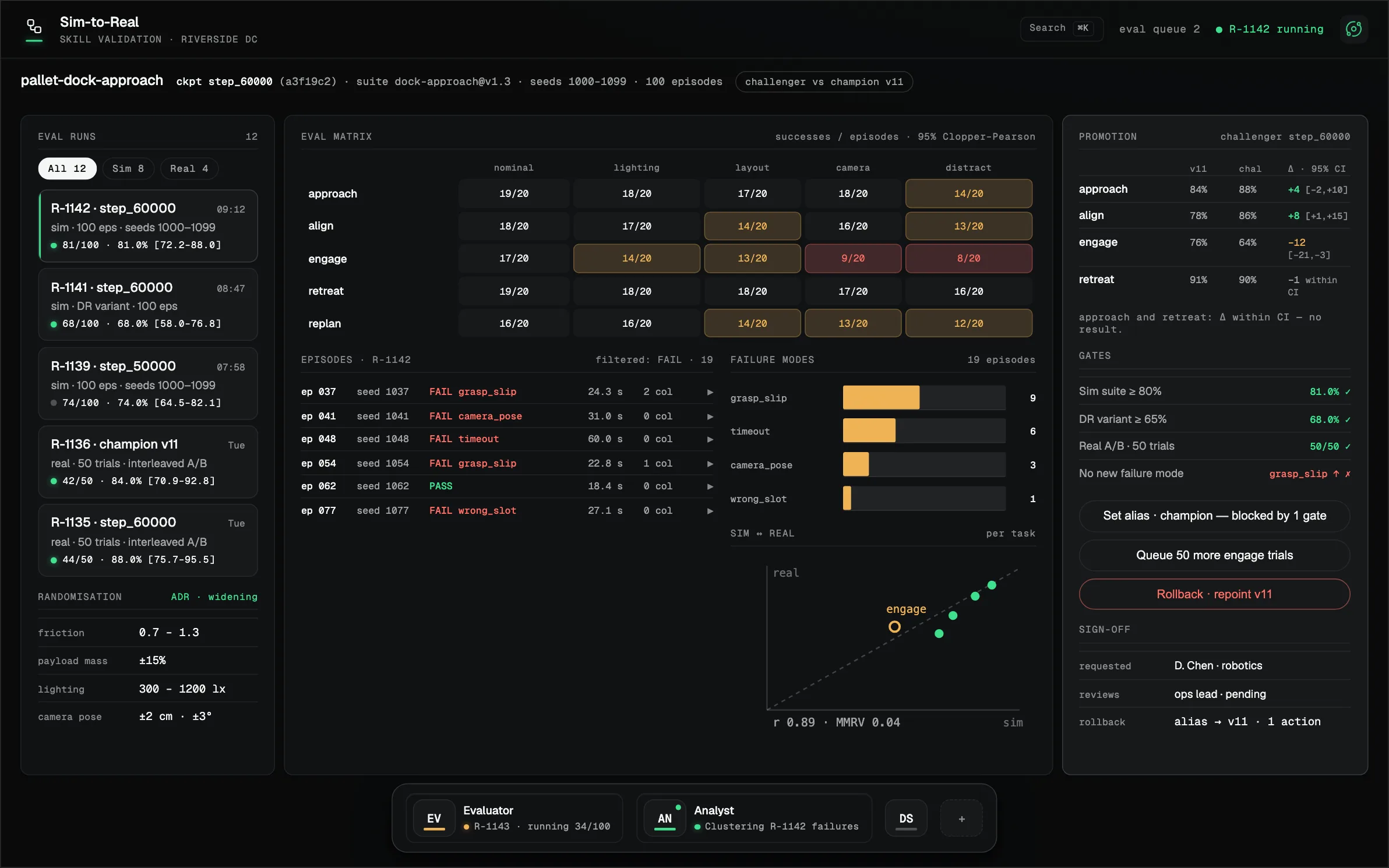
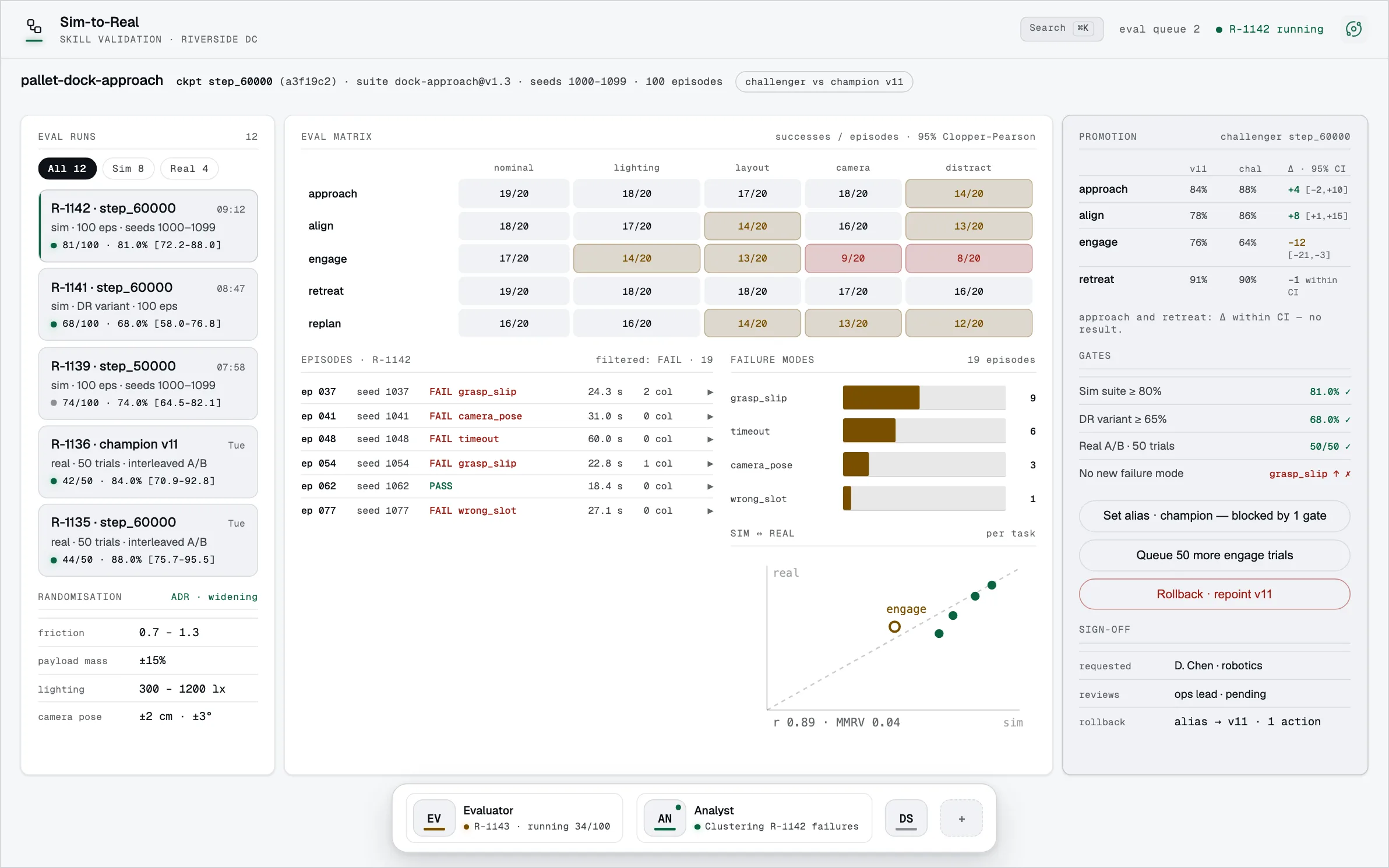
  • Illustrative Sim-to-Real sandbox validating an operation against a digital twin before live promotion.Illustrative Sim-to-Real sandbox validating an operation against a digital twin before live promotion.

    Simulation and sim-to-real

    Prove a skill before it touches the floor.

    Seeded runs, honest intervals, gated promotion.

    A skill is validated the way evidence demands, not the way a demo flatters: fixed suites of seeded episodes, an eval matrix that stresses the axes the floor will — lighting, layout, camera pose, distractors — and success reported as counts with confidence intervals. Challenger meets champion on identical seeds, and a difference inside the interval is reported as exactly that: no result. Promotion is a gated alias flip; rollback repoints to the version that held.

    • An eval matrix across tasks and perturbations
    • Counts with confidence intervals, not a percentage
    • Promotion gated, rollback a repoint
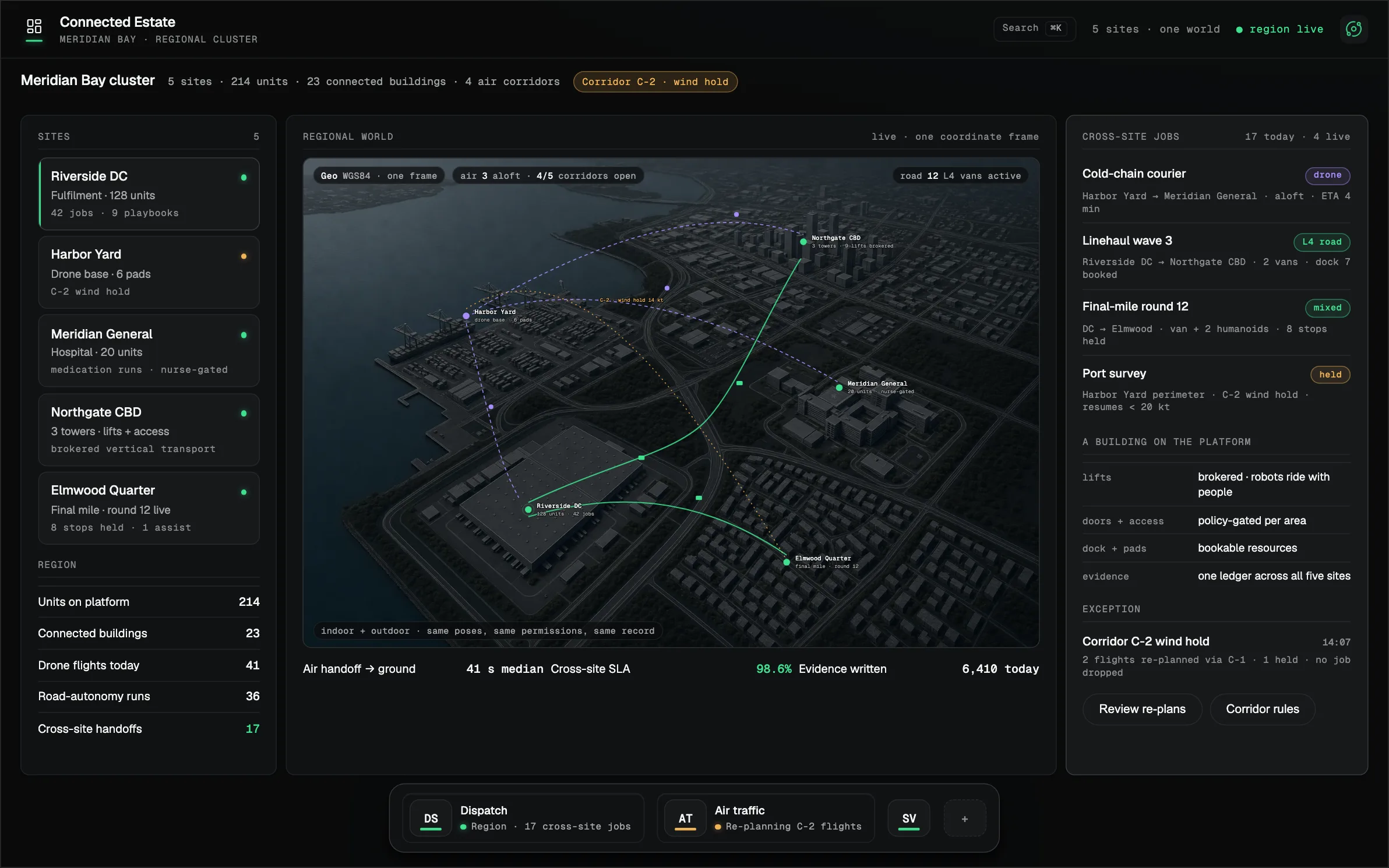
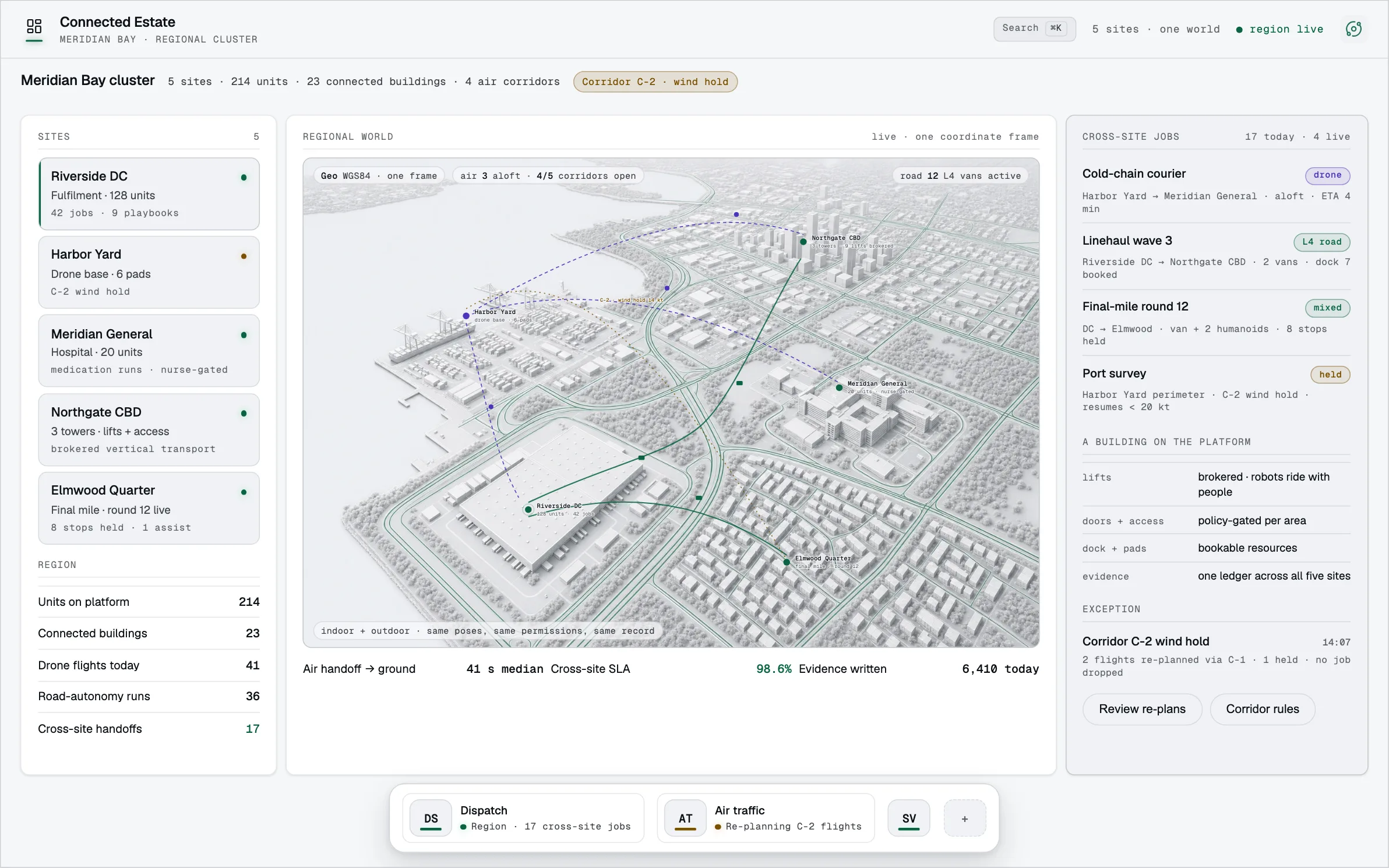
  • Illustrative Connected Estate console: system topology, connector health, and data freshness across sites.Illustrative Connected Estate console: system topology, connector health, and data freshness across sites.

    Adoption

    Add the platform without replacing what already works.

    Begin with one outcome; specialists keep their controls.

    QuikSync connects the systems already running the estate, productizes the cross-system work none of them owns alone, and expands through reusable applications, integrations, permission cases and evidence instead of a rip-and-replace program. Adoption starts from a scenario pack — a working operation installed as data, then diverged to your site. Start where the pain is measurable; grow where the proof already exists.

    • One bounded first outcome
    • No forced vendor-stack replacement
    • A reusable expansion path across sites and systems

Illustrative product concepts. Interfaces and data are representative.

Bring the first hard outcome

Turn fragmented systems into one product your estate can extend.