The Physical AI horizon

Every new body needs an operation to enter.

Physical AI is ready. Reality isn't. Models, humanoids and robots are accelerating faster than the world they must enter. QuikSync provides the operations platform that closes the gap: one live world, one authority path, and one operational record across every actor and system.

For a complex, multi-asset operation

How to read this

How to read this

The outer ring is perfection, and nobody sits on it. Where a dimension is still moving fastest for us, its point reaches outward. This is a directional view drawn from our own delivery experience, not an independent benchmark. Each comparison is a broad category rather than a single product: offerings within them differ widely and improve constantly, so read the shape as a guide to trade-offs rather than a verdict. We have drawn it honestly, including the dimensions where others lead. Where you land depends on your estate, your team and your constraints — we are glad to talk it through.

OrchestrationAuthorityEvidenceAgenticEvolveSpeed toDeployCustomizationScalabilityROIBreadthOpennessMaturity
  • QuikSync
  • FMS SaaS
  • Open Source Framework
Our own assessment, drawn from delivery experience and scored against broad categories rather than single products. Twelve dimensions, 1–5 in half steps, July 2026.
Scores and basis
Twelve dimensions scored 1–5 in half steps, assessed 2026-07-26. Higher is better on every axis.
DimensionQuikSyncFMS SaaSOpen Source FrameworkBasis
Orchestration & interoperability3/5rapidly evolving4/53.5/5Coordinating mixed fleets alongside lifts, doors, people and enterprise systems. FMS SaaS leads on fleet coordination and a connector inventory built over a decade. Open Source Framework has the deeper traffic negotiation, though you build and maintain every adapter. QuikSync covers the wider estate on connectors already in place.
Authority3/5rapidly evolving2.5/52/5Who may act, on what, and who approves it. QuikSync enforces identity, tenancy isolation and eligibility today, with human approval on supervised action. FMS SaaS offers role-based access. Open Source Framework leaves the action path to whoever builds it.
Evidence3/5rapidly evolving2.5/52/5One replayable record of what happened and why. QuikSync correlates the decision, the command, the effect and the approval across systems, and exports it. FMS SaaS keeps strong per-robot telemetry. Open Source Framework gives engineers excellent low-level replay, but the operational record is yours to assemble.
Agentic3.5/5rapidly evolving3/51/5Agents that observe, propose and recover — inside the same authority path as people. QuikSync governs what an agent may reach. FMS SaaS ships capable copilots and incident automation. Open Source Framework leaves the agentic layer to you — it is not what these stacks set out to provide.
Evolvability3.5/52.5/52/5What a change costs after go-live. On QuikSync it is a pack upload, not a redeploy. FMS SaaS moves at its own roadmap plus your integration work. Open Source Framework means rebuilding and redeploying, and a major version can break the adapters you wrote.
Speed to deploy3.5/53/52/5How fast an operation gets from proposal to handover. QuikSync authored a four-vendor, multi-floor operation in days, because packs and connectors preinstall the work. FMS SaaS gets robots running quickly, but estate integration is a separate project. Open Source Framework is an engineering programme before value.
Customization4/52.5/53/5How closely the platform expresses your operation as it actually runs. QuikSync declares it as data — blueprints, workflows, brokers and applications — with no code written per scenario. FMS SaaS gives a fixed configuration vocabulary, then an SDK. Open Source Framework permits anything at engineering cost, within the shape of whichever model you adopt.
Scalability3.5/54/53/5How far the platform stretches as the operation grows — more machines, more floors, more sites. FMS SaaS leads on proven fan-out across large fleets. QuikSync is built for estate scale on a clustered, event-driven core and is proving it site by site. Open Source Framework scales as far as the team operating it.
ROI3.5/53/52.5/5What compounds across sites, and what repeats. QuikSync keeps connectors, packs and workflows as reusable assets, so the next site starts further along. FMS SaaS returns value inside the robot scope. Open Source Framework carries no licence fee and a standing engineering payroll.
Breadth4/5rapidly evolving3/52/5How far one platform reaches beyond robot fleets. QuikSync runs airports, hospitals, facilities and depots, holding robots, infrastructure, people and non-robotic work in one model. FMS SaaS spans many robot types. Open Source Framework centres on mobile robots.
Openness & lock-in3.5/52.5/54.5/5How freely you can leave. Open Source Framework wins this outright: source you own and can fork. QuikSync keeps your operational logic as exportable data over standard interfaces, with machines staying on their native controllers. FMS SaaS is a proprietary service.
Maturity & ecosystem3/5fastest-moving4/53.5/5Track record, deployments and the ecosystem around the platform. FMS SaaS leads with years of production and named enterprise references. Open Source Framework has a genuine community behind it. QuikSync is the youngest here — the dimension to weigh against everything above.
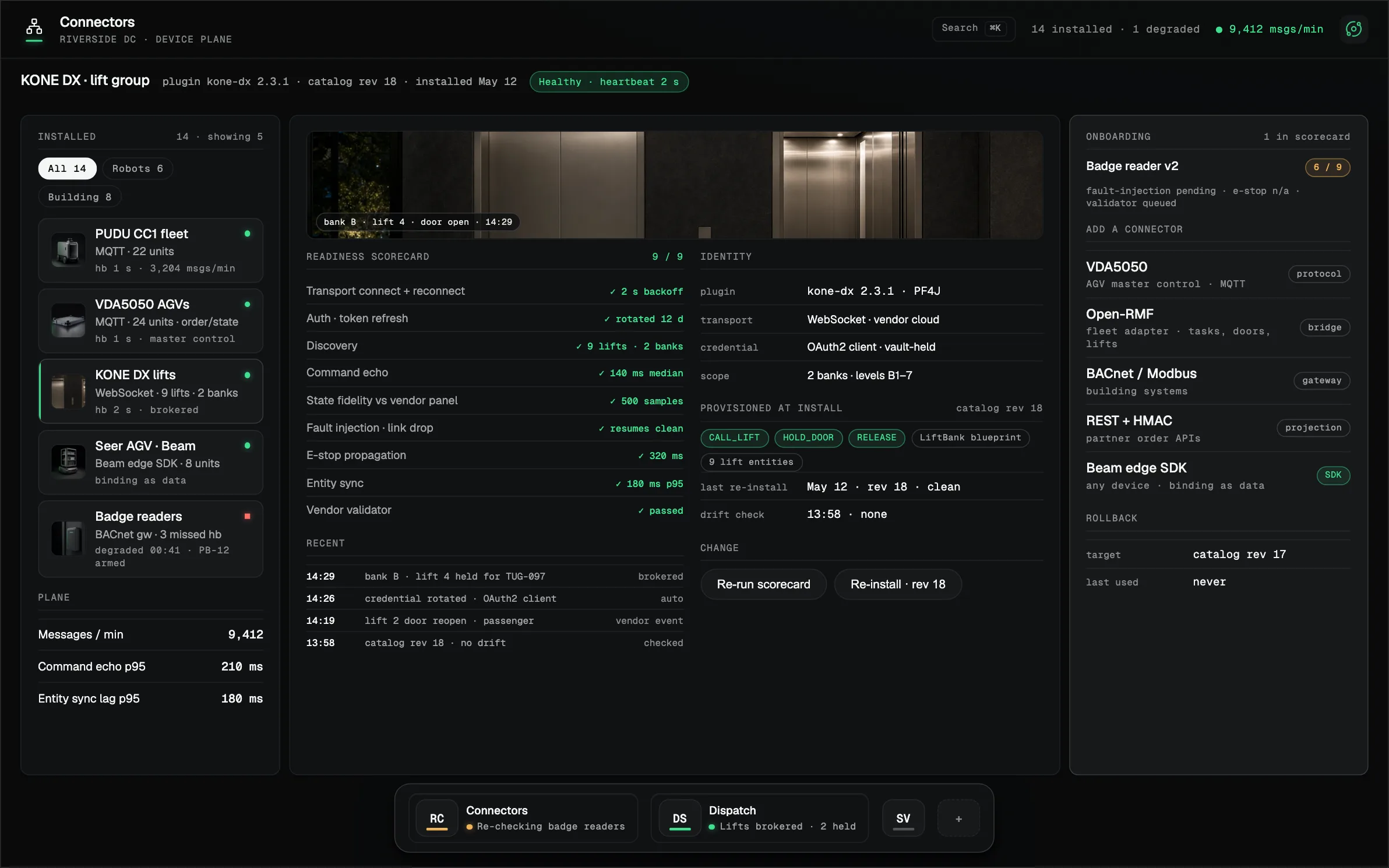
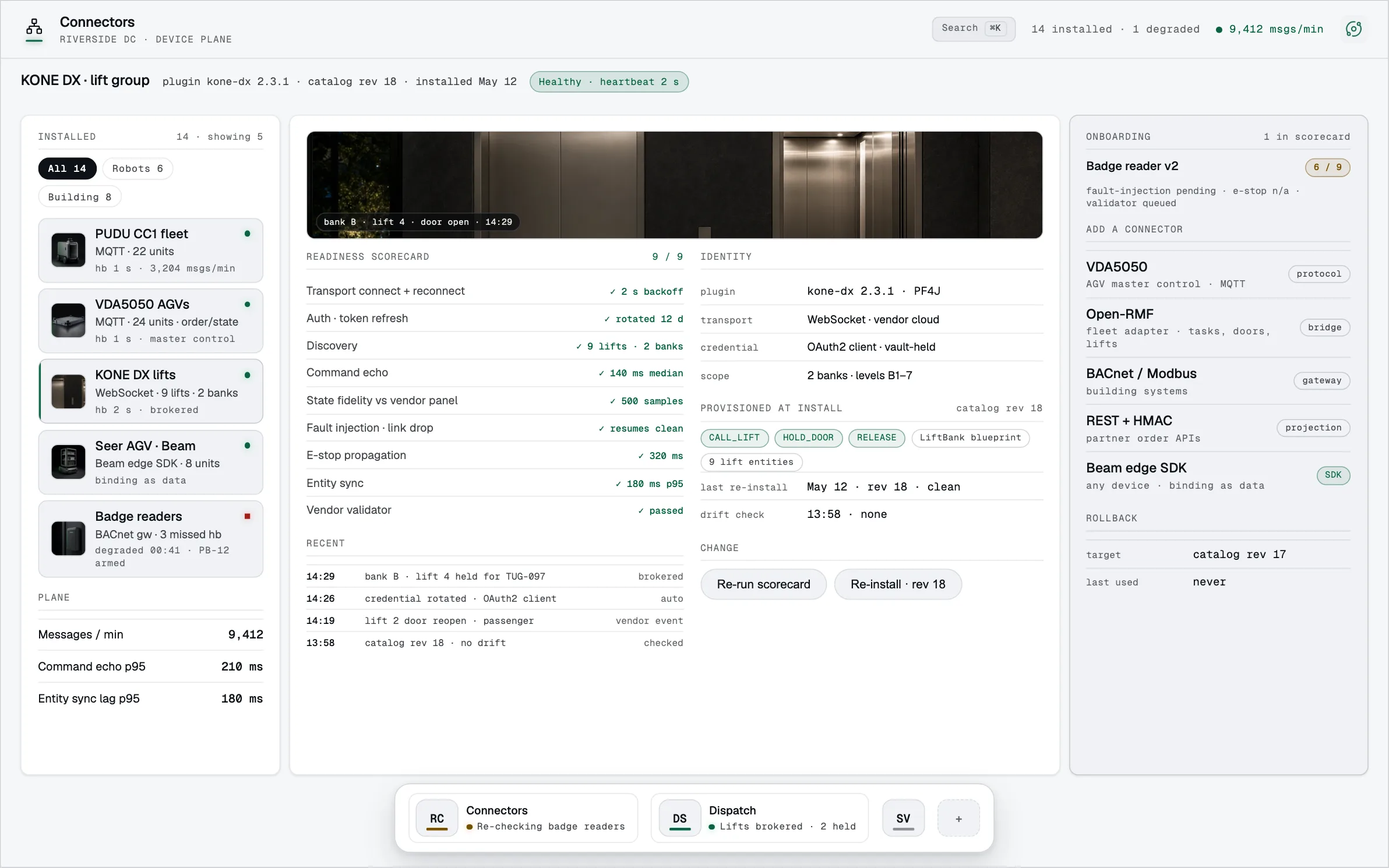
  • Illustrative Connectors console: a vendor plugin installed against live readiness checks, with machines and building systems on one plane.Illustrative Connectors console: a vendor plugin installed against live readiness checks, with machines and building systems on one plane.
    Illustrative product concept. Interfaces and data are representative.

    Embodied AI in enterprise operations

    Let any embodiment inherit the enterprise around it.

    Give new machines the operational context their models lack.

    A body or model should not need bespoke logic for every facility. Through a portable operational contract and connector framework, QuikSync hands embodied AI the work to do, the resources it may share, and the person to escalate to. That is what makes it an accountable participant.

    • Humanoids and emerging embodiments
    • Building and enterprise systems
    • Portable operational contracts and connectors
  • Richer operational worlds

    Move from asset state toward embodied world models.

    Give action the geometry, semantics, and time it needs.

    Research spans geometry, semantics, and causality, so future operations can reason about more than an asset list.

    • Geometry and occupancy
    • Semantic relations
    • Causal and temporal context
  • Evaluation and intelligence

    Turn real outcomes into a learning system.

    Make real outcomes the evaluation set for the next operation.

    Reviewable evidence becomes the substrate for evaluation, simulation, and progressively higher autonomy. This arc is The Model: every operation the platform runs makes the next one sharper.

    • Scenario and outcome evaluation
    • Simulation and counterfactuals
    • Operational learning loops
  • Insurable autonomy

    Opinions don't settle claims. Evidence does.

    The record becomes the evidence an underwriter can price.

    When an autonomous fleet causes a loss, the question is not whose story is better. It is what the record shows. QuikSync's operational evidence keeps the decision, the authority behind it, and the effect in one narrative, pointing toward insurable autonomy: coverage and claims priced on ground truth instead of after-the-fact reconstruction.

    • Evidence-first incident files
    • Authority and policy context alongside the action
    • A path to underwritable operations
  • Authority at the edge

    Bring identity, policy, evidence, and inference closer to effect.

    Extend the authority path toward the physical boundary.

    The Box is QuikSync's edge program: resilient capture, local authority, device-rooted evidence, and inference carried to the physical boundary itself.

    • Device-rooted identity
    • Resilient evidence capture
    • Local policy and inference
  • Why neutrality wins

    Serve every machine or system vendor without becoming one.

    No vendor is neutral at the boundary between systems.

    A machine vendor is structurally conflicted when it governs competitors. A general data platform can trigger action, but it is not purpose-built to carry live resource allocation and deployment-validated authority at the moment of physical effect. Neutrality in the authority path is a position, not a checkbox.

    • Vendor- and model-neutral authority
    • Shared infrastructure and resource allocation
    • Reusable applications, integrations, and evidence
  • Why the layer holds

    This is specialization, not a feature checklist.

    Copying the product means taking on the execution boundary.

    An incumbent can add an API, an agent, or a connector. Reproducing QuikSync means standing between systems in the authority path, carrying deployment-specific physical integrations and consequences, and rebuilding the accumulated operational world, applications, permission cases, and evidence.

    • Authority before actuation
    • Embodied operational context
    • Accumulated deployment assets
  • The operational contract

    The body is not the operation.

    Physical intelligence is outrunning the enterprise layer.

    A capable body can perceive, reason, and act. It still does not arrive with the customer's work, the building's rules, or the authority to act on either. The hard problem is not only making a machine intelligent. It is making many kinds of intelligence legible and operable inside a real place. The durable opportunity is the operational contract that lets any present or future embodiment inherit those things without rebuilding them at every site.

    • Bodies and models keep improving
    • Enterprise context remains customer-specific
    • The operational contract compounds across both

The three pillars

Software, intelligence, and hardware on the horizon.

The platform coordinates mixed assets into one accountable operation, the model turns every run into sharper intelligence, and a co-developed hardware layer is coming to carry that trust down to the silicon. Each pillar feeds the next.

Software

The Core

The software that runs the whole mixed-asset operation. Vendor-agnostic orchestration and governance, from dispatch to compliance.

  • Fleet OrchestrationVendor-agnostic coordination across mixed-asset fleets with real-time dispatch.
  • Agent DeckOne operator console for copilot, incidents, and live authority on a single page.
  • Scenario ComposerCompose the ontology and workflows on a canvas. Drag, connect, deploy.
  • Permission PlaneIdentity, eligibility, allocation and human authority, resolved against the live operation.
  • Operations LedgerA correlated, replayable record that an autonomous deployment is answerable to.
Intelligence

The Model

Every operation becomes data that sharpens the next and grounds reasoning in the physical world.

  • World ModelA foundation model grounded in physical-world reasoning, joined to a live spatial twin.
  • Agentic PlannerDescribe intent in plain language; multi-agent crews orchestrate the execution.
  • Supervised Immune SystemDetects stalls and drift, opens incidents, and routes them to an operator to approve.
  • Scenario FoundryMonths of custom integration reduced to instant scenario generation.
  • Sim-to-RealValidate operations in a physics-accurate simulation crucible, then promote to real deployment.
Hardware · In development

The Box

A co-developed hardware layer that carries trust to the edge, with cryptographic identity and on-device intelligence at the source. In development with silicon partners.

  • Hardware root-of-trustPer-device cryptographic identity and secure boot, so trust starts in silicon.
  • On-device inferenceEdge AI for autonomous safety decisions when the network can't be relied on.
  • Evidence at the sourceTamper-evident capture, so the operational record begins where the action happens.
  • Universal bridgeOn-box protocol translation for any connected device or robot.
  • Spatial sensingPositioning and geofencing fused across ground and aerial assets.

Ground truth compounds into intelligence — the flywheel that turns every operation into an asset that appreciates.

The whole system

One platform, every layer from operator intent to device firmware.

The three pillars run on one architecture. A request enters from the people and systems above, crosses the authority path, and reaches the machines below. Pick a perspective to see the layers each stakeholder depends on.

I'm a

A full-stack AI-native operations platform for autonomous units, from operator interface to device firmware, every layer purpose-built to work as one. Select a perspective above to see how each stakeholder benefits from clean separation of concerns.

Reality
Engineers
Operators
End Users
Business Applications
AI Agents
Connected Devices
External Systems
Scenario

Pre-built domain templates — most of what a new site needs, already shipped.

Empower
Orchestrate
Operation

An ontology graph models the entities, a workflow graph composes their actions, a knowledge graph retains what runs.

Integration

Wire-level protocols reach any device, native adapters fold vendor systems into the fleet, one planner schedules the whole.

Govern
Physical AI
Humanoid Robots
Drones & UAVs
Elevators & Doors
Service Robots, AMRs & AGVs
Sensors & Cameras
Autonomous Vehicles
Warehouse Automation
Industrial Automation

Build the next operational contract

Give every new embodiment an enterprise world to join.